
5th AMENDMENT
CONSTITUTIONAL RIGHT
-
Download FREE PDF Format - Your Rights! (Click Link)
- FIFTH AMENDMENT
What Are My 5th Amendment Protecting Due Process, Fairness and the Right to Remain Silent…
FAQ’s Bottom of Page…
FIFTH AMENDMENT
Fairness & The Right to Remain Silent
“No person shall be held to answer for a capital, or otherwise infamous crime, unless on a presentment or indictment of a Grand Jury… nor shall any person be subject for the same offence to be twice put in jeopardy of life or limb; nor shall be compelled in any criminal case to be a witness against himself, nor be deprived of life, liberty, or property, without due process of law; nor shall private property be taken for public use, without just compensation.”
When someone says “I plead the Fifth,” they are invoking one of the most powerful protections in the entire Bill of Rights — the right not to incriminate yourself. But the Fifth Amendment is much broader than that single phrase. It protects against double jeopardy, guarantees due process, and limits the government’s ability to take private property.
The Right to Remain Silent — What It Really Means
The Fifth Amendment gives you the right to refuse to answer questions from law enforcement if your answers could potentially incriminate you. This applies whether you are arrested, detained, or simply approached on the street.
Critical points to understand:
- You must assert the right. Simply staying quiet is not enough. The Supreme Court ruled in Berghuis v. Thompkins (2010) that you need to clearly invoke your right. Say: “I am invoking my right to remain silent and I want an attorney.”
- Anything you say can and will be used against you. The Miranda warning exists for a reason. Volunteering information — even to explain yourself — can create legal problems you didn’t anticipate.
- The right applies even before arrest. You do not have to wait to be read your rights to exercise them. You can decline to answer questions at any time.
Double Jeopardy — You Cannot Be Tried Twice for the Same Crime
The Fifth Amendment’s double jeopardy clause means that once you have been acquitted of a crime, the government cannot try you again for that same offense. If a jury finds you not guilty, that verdict is final.
Important nuances:
- State and federal governments are separate sovereigns, so you can be charged by both for the same conduct in some circumstances.
- A mistrial does not trigger double jeopardy protection in most cases.
- Civil lawsuits are not covered — an acquittal in criminal court does not prevent a civil suit.
Due Process — The Government Must Follow the Rules
The due process clause requires that the government follow fair procedures before depriving you of life, liberty, or property. In practice, this means:
- You have the right to notice before legal action is taken against you.
- You have the right to be heard and to present your side.
- The government cannot arbitrarily take your property, freedom, or rights without going through proper legal channels.
Eminent Domain — When the Government Takes Your Property
The Fifth Amendment’s “takings clause” allows the government to take private property for public use — but only with just compensation. If the government wants to build a road through your land, they must pay you fair market value.
If you believe you have not received just compensation, you have legal recourse to challenge the amount in court.
What to Say During a Police Encounter
- “I am invoking my right to remain silent.”
- “I do not consent to any searches.”
- “I want to speak with an attorney before answering any questions.”
Say these things calmly and clearly. Then stop talking. Do not explain, justify, or elaborate — doing so can only hurt you legally.
Know Your Rights — In Your Hands, Wherever You Go
The Fifth Amendment is one of the most critical rights in any police encounter, and it’s clearly explained on our Know Your Rights Cards. Keep one in your wallet so you have the language you need, when you need it.
[Shop the Know Your Rights Card Set →]
The information on this page is provided for educational purposes only and does not constitute legal advice. If you believe your rights have been violated, consult a qualified attorney in your state.
The Fifth Amendment: Your Right to Remain Silent and Due Process Protections
Few constitutional phrases are more widely known — and more widely misunderstood — than “pleading the Fifth.” The Fifth Amendment is not a loophole for the guilty. It is a bedrock protection ensuring that the government cannot force any person to be a witness against themselves. It also guarantees due process, protects against being tried twice for the same crime, and limits the government’s power to seize your property.
Here is what it actually means, how it works in the real world, and exactly what to say when you need to use it.
What the Fifth Amendment Actually Says
“No person shall be held to answer for a capital, or otherwise infamous crime, unless on a presentment or indictment of a Grand Jury, except in cases arising in the land or naval forces, or in the Militia, when in actual service in time of War or public danger; nor shall any person be subject for the same offence to be twice put in jeopardy of life or limb; nor shall be compelled in any criminal case to be a witness against himself, nor be deprived of life, liberty, or property, without due process of law; nor shall private property be taken for public use, without just compensation.”
— U.S. Constitution, Amendment V
Plain-Language Summary
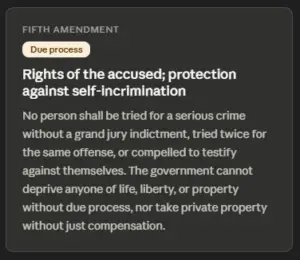
The Fifth Amendment contains five distinct protections packed into one sentence:
- Grand jury requirement — Federal charges for serious crimes must be approved by a grand jury
- Double jeopardy protection — You cannot be tried twice for the same crime after acquittal or conviction
- Right against self-incrimination — You cannot be forced to testify against yourself
- Due process — The government cannot take your life, liberty, or property without fair legal process
- Takings clause — If the government takes your property, it must pay you fair compensation
Of these, the right against self-incrimination and due process are the ones most relevant to everyday encounters with law enforcement.
The Right to Remain Silent
The most powerful and most misunderstood protection in the Fifth Amendment is the right against self-incrimination — the right to remain silent.
You cannot be legally compelled to say anything that could be used against you in a criminal proceeding. This right applies whether you are a suspect, a witness, or someone simply caught in a difficult situation. It applies before arrest, during arrest, and during trial.
The Exact Words to Say
Courts have held that you must affirmatively invoke your right to remain silent. Staying quiet alone may not be enough — in Berghuis v. Thompkins (2010), the Supreme Court ruled that a suspect who sat silently for hours before eventually speaking had not clearly invoked the right. You must say it out loud.
Use this exact language:
“I am invoking my right to remain silent. I will not answer questions without an attorney present.”
Say it once, clearly. Then stop talking. You do not need to explain yourself, justify your silence, or engage further. Anything you say after invoking this right can still be used against you — so stop after the invocation.
What Happens After You Invoke
Once you clearly invoke your right to remain silent and ask for an attorney, police are required to stop questioning you. If they continue questioning you and you answer, courts may find that you waived your rights. The safest approach: invoke, then stay silent until your attorney is present.
Miranda Rights and the Fifth Amendment
Miranda rights come directly from the Fifth Amendment. In Miranda v. Arizona (1966), the Supreme Court ruled that before police can interrogate a person in custody, they must warn that person of their constitutional rights.
The standard Miranda warning covers:
- You have the right to remain silent
- Anything you say can and will be used against you in a court of law
- You have the right to an attorney
- If you cannot afford an attorney, one will be appointed for you
Common Misconceptions About Miranda
“They didn’t read me my rights — the case will be thrown out.” Not necessarily. Miranda warnings are only required before a custodial interrogation — meaning you are in police custody AND being questioned. If police arrest you but do not question you, they are not required to Mirandize you. Failure to give Miranda warnings means statements made during that interrogation may be excluded — but the arrest itself stands.
“I have to answer questions if I haven’t been Mirandized yet.” No. Your right to remain silent exists at all times — before, during, and after arrest — whether or not you have been read your rights.
“Anything I say before arrest can’t be used against me.” Wrong. Voluntary statements made before arrest and before any custodial interrogation are generally admissible. The Fifth Amendment protects you from being compelled to speak — it does not protect voluntary statements you choose to make.
Double Jeopardy: You Cannot Be Tried Twice
The Double Jeopardy Clause prevents the government from prosecuting you a second time for the same crime after you have been acquitted or convicted.
The protection attaches once jeopardy “attaches” — in a jury trial, when the jury is sworn in; in a bench trial, when the first witness is sworn in.
Important Limits on Double Jeopardy
Separate sovereigns: The federal government and state governments are separate sovereigns. A state acquittal does not bar a federal prosecution for the same conduct, and vice versa. This is how someone can be acquitted in state court and still face federal charges — as seen in several high-profile civil rights cases.
Mistrials: If a jury cannot reach a verdict (hung jury), jeopardy has not terminated and the government can retry the case.
Appeals: If you are convicted and successfully appeal, the government can retry you without violating double jeopardy.
Due Process: The Government Must Play Fair
The Fifth Amendment’s Due Process Clause prohibits the federal government from depriving any person of “life, liberty, or property” without due process of law. The Fourteenth Amendment extends this protection against state governments.
Due process comes in two forms:
Procedural due process means the government must follow fair procedures before depriving you of life, liberty, or property — proper notice, a hearing, an opportunity to be heard.
Substantive due process means certain rights are so fundamental that the government cannot infringe on them at all, regardless of the procedures used. Courts have used substantive due process to protect rights ranging from the right to marry to the right to raise your children.
The Takings Clause: Fair Compensation for Your Property
The Fifth Amendment’s final clause — “nor shall private property be taken for public use, without just compensation” — limits the government’s power of eminent domain: its ability to seize private property for public use.
If the government takes your property — for a road, a school, a public utility — it must pay you fair market value. The taking must also be for a genuine public use, though courts have interpreted this broadly.
In Kelo v. City of New London (2005), the Supreme Court controversially ruled that economic development could constitute a public use, allowing a city to take private homes and transfer them to a private developer. The decision prompted significant public backlash and many states subsequently passed laws restricting the use of eminent domain for economic development.
Grand Jury Requirement
For serious federal crimes — felonies — the Fifth Amendment requires that charges be brought through a grand jury indictment. A grand jury is a group of citizens (typically 16–23 people) who review evidence presented by prosecutors and determine whether there is probable cause to charge someone with a crime.
Grand jury proceedings are secret and one-sided — only the prosecution presents evidence. The standard of proof is probable cause, not proof beyond a reasonable doubt. Grand juries indict the vast majority of cases brought to them, which has given rise to the famous observation that a prosecutor could “indict a ham sandwich.”
Note: This requirement applies to federal prosecutions. Most states do not require grand jury indictments and use a different process called a preliminary hearing.
Landmark Fifth Amendment Cases
Miranda v. Arizona (1966) — Police must warn suspects in custody of their Fifth Amendment rights before interrogation. Any statement obtained without these warnings is inadmissible in court. Established the “Miranda warning” used by law enforcement nationwide.
Kastigar v. United States (1972) — The government can compel testimony from a witness who invokes the Fifth Amendment by granting immunity — but it must be “use and derivative use” immunity, meaning the testimony and anything derived from it cannot be used against the witness.
Berghuis v. Thompkins (2010) — Suspects must clearly and affirmatively invoke the right to remain silent. Simply staying quiet for an extended period is not enough. This decision underscores the importance of explicitly stating your invocation.
Salinas v. Texas (2013) — The Supreme Court held that a person’s silence in response to police questioning before arrest — and before invoking the Fifth Amendment — can be used against them at trial. This is why explicitly invoking the right matters even before you are in custody.
Kelo v. City of New London (2005) — Economic development can constitute a “public use” justifying eminent domain. A deeply controversial decision that many states have since legislatively overruled at the state level.
United States v. Hubbell (2000) — The act of producing documents in response to a subpoena can itself be a form of self-incrimination if the act of production communicates incriminating facts.
Real-World Scenarios
“Police pulled me over and started asking questions.”
You are required to provide your name, driver’s license, registration, and proof of insurance during a traffic stop. Beyond that, you can say: “I am invoking my right to remain silent.” You do not have to answer questions about where you are going, where you came from, or whether you have been drinking.
“I was arrested and police want to question me.”
Say clearly: “I am invoking my right to remain silent and I want an attorney.” Then stop talking. Do not try to explain your innocence, provide context, or “clear things up.” Anything you say can and will be used against you. Wait for your attorney.
“I was called to testify before a grand jury or at trial.”
You can invoke the Fifth Amendment as a witness, not just as a defendant. If answering a question could expose you to criminal liability, you can refuse to answer by saying: “I respectfully invoke my Fifth Amendment right and decline to answer on the grounds that it may incriminate me.” Consult an attorney before any grand jury appearance.
“The government wants to take my property for a road project.”
You are entitled to just compensation — fair market value. You are not required to accept the government’s initial offer. You have the right to hire an appraiser and challenge the valuation in court. An eminent domain attorney can help you negotiate or litigate for a fair price.
“I was acquitted of a crime and prosecutors seem to be pursuing the same conduct again.”
Understand the separate sovereigns doctrine. A state acquittal does not bar federal charges for the same conduct if federal laws were also violated. If you are facing potential double prosecution, consult an attorney immediately to assess whether double jeopardy protections apply.
Frequently Asked Questions
Q: What does “pleading the Fifth” mean? “Pleading the Fifth” means invoking your Fifth Amendment right not to answer a question that could incriminate you. It is not an admission of guilt — it is a constitutional right that applies to everyone, guilty or innocent. You can invoke it during police questioning, at a deposition, or while testifying in any legal proceeding.
Q: Can I plead the Fifth in a civil case? Yes. The Fifth Amendment’s protection against self-incrimination applies in any proceeding — civil or criminal — where your answer could expose you to criminal liability. However, in a civil case, a judge or jury may draw a negative inference from your silence.
Q: Do I have to answer police questions if I’m not under arrest? You are generally not required to answer questions beyond identifying yourself (in states with stop-and-identify laws). You can invoke your right to remain silent at any time by saying: “I am invoking my right to remain silent.” This is true whether or not you have been arrested.
Q: What are Miranda rights? Miranda rights are the warnings police must give before a custodial interrogation: that you have the right to remain silent, that anything you say can be used against you, and that you have the right to an attorney. They stem from the Supreme Court’s 1966 decision in Miranda v. Arizona.
Q: What happens if police don’t read me my Miranda rights? Statements you made during a custodial interrogation without Miranda warnings may be inadmissible in court. However, the arrest itself is not automatically invalid, and other evidence gathered independently may still be used. Failure to Mirandize does not automatically mean your case is dismissed.
Q: Can my silence be used against me? Under Salinas v. Texas (2013), if you are not in custody and have not yet invoked the Fifth Amendment, your silence in response to a question can potentially be used against you. This is why explicitly saying “I am invoking my right to remain silent” — rather than just going quiet — is critical.
Q: What is double jeopardy? Double jeopardy is the constitutional protection against being tried twice for the same crime by the same sovereign after an acquittal or conviction. It does not prevent federal prosecution after a state acquittal, or a retrial after a hung jury.
Q: What is due process? Due process means the government must follow fair procedures before depriving you of life, liberty, or property. Procedural due process requires proper notice and a fair hearing. Substantive due process protects certain fundamental rights from government interference regardless of procedure.
Q: If the government takes my land, what am I entitled to? You are entitled to “just compensation” — generally interpreted as fair market value of the property taken. You are not required to accept the government’s initial offer and can challenge the valuation in court.
Q: Can I invoke the Fifth Amendment to avoid testifying against someone else? No. The Fifth Amendment only protects you from being compelled to incriminate yourself. You cannot refuse to testify about another person’s actions solely to protect them — only to protect yourself from criminal exposure.
Know Your Rights in the Moment
These are the only phrases you need for Fifth Amendment protection:
- To stop questioning: “I am invoking my right to remain silent.”
- To request an attorney: “I want an attorney present before I answer any questions.”
- To invoke at testimony: “I respectfully invoke my Fifth Amendment right and decline to answer on the grounds that it may incriminate me.”
Say the words. Say them clearly. Then stop talking.
Related Amendments
The Fifth Amendment works in close partnership with other constitutional protections:
- Fourth Amendment — Protects you from unreasonable searches before any questioning begins. Invoke both at a traffic stop or arrest.
- Sixth Amendment — Guarantees your right to an attorney. When you invoke the Fifth, also invoke the Sixth by asking for a lawyer.
- Fourteenth Amendment — Extends Fifth Amendment due process protections against state governments, not just the federal government.
Disclaimer
The information on this page is educational and does not constitute legal advice. Laws vary by jurisdiction and individual circumstances matter significantly. If you are facing a criminal investigation, arrest, or government action affecting your property or liberty, consult a licensed attorney immediately.
