
4th AMENDMENT
CONSTITUTIONAL RIGHT
-
Download FREE PDF Format - Your Rights! (Click Link)
- FOURTH AMENDMENT
What Are My 4th Amendment Rights to Privacy and Protection from Unreasonable Searches…
FAQ’s Bottom of Page…
FOURTH AMENDMENT
Privacy & Protection from Unreasonable Searches
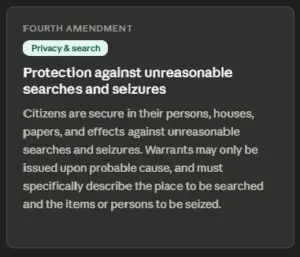
“The right of the people to be secure in their persons, houses, papers, and effects, against unreasonable searches and seizures, shall not be violated, and no Warrants shall issue, but upon probable cause, supported by Oath or affirmation, and particularly describing the place to be searched, and the persons or things to be seized.”
The Fourth Amendment is one of the most directly relevant constitutional rights in everyday life. It governs what law enforcement can and cannot do when they want to search your home, your car, your phone, or your person. Understanding it could be the difference between protecting your rights and unknowingly giving them up.
What Does “Unreasonable Search and Seizure” Mean?
The Fourth Amendment does not ban all searches — it bans unreasonable ones. In practice, this means law enforcement generally needs one of three things to conduct a lawful search:
1. A Warrant — A judge has reviewed the evidence and determined there is probable cause to believe a crime has been committed and that the location to be searched is connected to it.
2. Probable Cause — Even without a warrant, officers may search if they have specific, articulable facts suggesting criminal activity. This is a higher standard than a hunch.
3. Your Consent — If you voluntarily agree to a search, you waive your Fourth Amendment protection. You are never required to consent, and doing so does not help you legally.
Your Rights During a Traffic Stop
The traffic stop is where most Americans will encounter Fourth Amendment issues firsthand.
- You do not have to consent to a vehicle search. If an officer asks, “Mind if I take a look?” you can calmly respond: “I do not consent to a search.”
- Officers can search without consent if they have probable cause. The smell of marijuana, visible contraband, or other specific evidence can give an officer grounds to search without your permission.
- A K-9 sniff is not a search — but it can create probable cause. If a drug detection dog alerts on your vehicle, that may give an officer grounds to search.
- You cannot be detained indefinitely without reasonable suspicion. A traffic stop must be brief and related to the stop itself. Prolonged detentions to wait for a dog sniff may be unconstitutional depending on the circumstances.
Your Home, Your Castle
Your home receives the strongest Fourth Amendment protection of any space. As a general rule:
- Officers need a warrant to enter your home.
- Exceptions exist for emergency situations (such as hot pursuit of a fleeing suspect or imminent danger).
- You have the right to refuse entry if they do not have a warrant. Calmly state: “I do not consent to entry without a warrant.”
- If they enter anyway, do not physically resist — document everything and contact an attorney.
Digital Privacy and the Fourth Amendment
Courts are still catching up to the digital age, but recent rulings have significantly expanded Fourth Amendment protections online.
- In Riley v. California (2014), the Supreme Court unanimously ruled that police generally need a warrant to search a cell phone seized during an arrest.
- In Carpenter v. United States (2018), the Court ruled that accessing historical cell-site location data requires a warrant.
- Your emails, cloud storage, and digital communications are increasingly recognized as protected — though the law continues to evolve.
Common Misconceptions
“If I have nothing to hide, I have nothing to fear.” Consenting to a search waives your rights regardless of what is found. Even innocent people benefit from asserting their Fourth Amendment protections.
“The officer said I had to let them search.” Saying you must comply is not the same as having legal authority. You may calmly decline and ask if you are being detained or are free to go.
Know Your Rights — In Your Hands, Wherever You Go
The Fourth Amendment is on every one of our Know Your Rights Cards and Visor Placards. Keep the information where you can access it quickly — before, during, and after any police encounter.
[Shop the Know Your Rights Card Set →]
The information on this page is provided for educational purposes only and does not constitute legal advice. If you believe your rights have been violated, consult a qualified attorney in your state.
The Fourth Amendment: Your Right to Privacy and Protection from Unreasonable Searches
The Fourth Amendment is the most practically relevant constitutional right for everyday Americans. It determines what police can and cannot do when they pull you over, knock on your door, or ask to search your belongings. Understanding it — in plain language — can make a real difference in how you respond in the moment.
What the Fourth Amendment Actually Says
“The right of the people to be secure in their persons, houses, papers, and effects, against unreasonable searches and seizures, shall not be violated, and no Warrants shall issue, but upon probable cause, supported by Oath or affirmation, and particularly describing the place to be searched, and the persons or things to be seized.”
— U.S. Constitution, Amendment IV
Plain-Language Summary
The Fourth Amendment does two things: it protects you from unreasonable government searches and seizures, and it sets the rules for when a search warrant can be issued. In practice, this means that before police can search your home, your car, or your person, they generally need either a valid warrant or a legally recognized reason to act without one.
The amendment covers your body, your home, your vehicle, your papers, and — as courts have increasingly recognized — your digital devices and data.
What “Unreasonable” Actually Means
Not every search is unconstitutional — only unreasonable ones. Courts use a two-part test first established in Katz v. United States (1967):
- Did you have a subjective expectation of privacy in the thing or place searched?
- Is that expectation one that society recognizes as reasonable?
If both are true, the Fourth Amendment applies, and police generally need a warrant or a recognized exception to proceed.
The Warrant Requirement
A search warrant is a written court order authorizing police to search a specific place for specific things. To get one, officers must:
- Appear before a judge or magistrate
- Demonstrate probable cause — a reasonable belief, based on facts, that evidence of a crime will be found
- Describe specifically the place to be searched and the items they’re looking for
A warrant is not a blank check. Police must search only the area and items described. If a warrant authorizes a search of your garage, officers cannot use it to search your bedroom.
Your Rights During a Search
Whether or not a warrant is present, you have rights during any search:
- You can refuse consent. Clearly say: “I do not consent to a search.” This protects your rights even if the officer searches anyway — a warrantless, non-consensual search may later be found unconstitutional.
- You do not have to answer questions beyond providing your name and, during a traffic stop, your license, registration, and proof of insurance.
- You do not have to physically resist. Assert your rights verbally and let the courts handle the rest. Physical resistance can escalate the situation and create new legal problems.
Exceptions to the Warrant Requirement
Courts have recognized several situations where police can search without a warrant. These are real and commonly used — knowing them helps you understand what’s happening if you find yourself in one.
1. Consent
If you voluntarily agree to a search, police do not need a warrant. You have the right to refuse. Saying nothing, or stepping aside, can be interpreted as consent. Always say clearly: “I do not consent to this search.”
2. The Automobile Exception
If police have probable cause to believe your vehicle contains evidence of a crime, they can search it without a warrant. This exception was established in Carroll v. United States (1925) and remains one of the most commonly invoked.
3. Search Incident to Lawful Arrest
When police lawfully arrest you, they can search your person and the area within your immediate reach — to find weapons and prevent destruction of evidence. Under Arizona v. Gant (2009), they generally cannot search your entire vehicle solely because they arrested the driver.
4. Plain View Doctrine
If an officer is lawfully present somewhere and sees evidence of a crime in plain view, they can seize it without a warrant. The incriminating nature must be immediately apparent.
5. Exigent Circumstances
Police can enter without a warrant in genuine emergencies — pursuing a fleeing suspect, preventing imminent destruction of evidence, or responding to a threat to life. Courts examine these situations carefully after the fact.
6. Terry Stops (Stop and Frisk)
Under Terry v. Ohio (1968), police can briefly detain and pat down your outer clothing for weapons if they have reasonable suspicion — a lower standard than probable cause — that criminal activity is afoot and you may be armed. A Terry stop is not a full search.
7. Inventory Searches
When police lawfully impound your vehicle, they can conduct a standardized inventory search of its contents. This is not a criminal search but an administrative one, and does not require probable cause.
Probable Cause vs. Reasonable Suspicion
These two standards appear constantly in Fourth Amendment law. Understanding the difference matters.
Probable cause is a reasonable belief, based on specific and articulable facts, that a crime has been committed or that evidence of a crime will be found. It is required for arrests and for most warrantless searches.
Reasonable suspicion is a lower bar — a specific, articulable reason to believe criminal activity is occurring. It justifies a brief investigatory stop (Terry stop) but not a full search or arrest.
A police hunch is not enough for either standard. Officers must be able to point to specific, observable facts.
Your Phone and Digital Privacy
Courts have significantly extended Fourth Amendment protections into the digital world.
Your cell phone: In Riley v. California (2014), the U.S. Supreme Court ruled unanimously that police cannot search the contents of your cell phone during an arrest without a warrant. Chief Justice Roberts wrote that a cell phone “holds for many Americans the privacies of life.” If you are arrested, police cannot scroll through your phone without a warrant.
Your location data: In Carpenter v. United States (2018), the Supreme Court ruled that police generally need a warrant to obtain historical cell-site location data from your wireless carrier. The government cannot track your movements over time without judicial oversight.
Your home computer and email: Courts have consistently held that the contents of your computer and your email require a warrant to access.
Practical tip: You are not required to provide your phone’s passcode to police. Stating “I do not consent to a search of my device” invokes your rights clearly.
The Exclusionary Rule: What Happens When Police Violate the Fourth Amendment
If police conduct an unconstitutional search, the evidence they find may be excluded from trial. This is called the exclusionary rule, applied to state law enforcement through Mapp v. Ohio (1961).
The doctrine extends to the fruit of the poisonous tree — evidence discovered as a result of an unconstitutional search is also inadmissible, even if the secondary evidence was obtained through legal means.
There are exceptions to the exclusionary rule (good faith, inevitable discovery, independent source), which is why having an attorney review your case matters when you believe your rights were violated.
Landmark Fourth Amendment Cases
These Supreme Court decisions define the law as it exists today.
Mapp v. Ohio (1961) — Applied the exclusionary rule to state courts. Evidence obtained through unconstitutional searches cannot be used against you in a state criminal trial.
Katz v. United States (1967) — Established the “reasonable expectation of privacy” test. The Fourth Amendment protects people, not just places. A phone call made from a public phone booth is still private.
Terry v. Ohio (1968) — Authorized brief investigatory stops and pat-downs based on reasonable suspicion. Defined the legal basis for stop-and-frisk.
Carroll v. United States (1925) / Chambers v. Maroney (1970) — Established and reinforced the automobile exception to the warrant requirement.
Riley v. California (2014) — Police must obtain a warrant before searching the contents of a cell phone seized during an arrest.
Carpenter v. United States (2018) — Government access to historical cell-site location records requires a warrant.
Arizona v. Gant (2009) — Police cannot search a vehicle incident to arrest when the person is secured and cannot access the vehicle.
Real-World Scenarios
“An officer pulled me over and asked to search my car.”
You can say: “I do not consent to a search of my vehicle.” Say it calmly and clearly. The officer may still search if they develop probable cause during the stop (such as seeing something in plain view or detecting an odor), but your refusal is documented and protects you legally.
“Police knocked on my door and asked to come in.”
You are not required to open your door unless police have a warrant. You can speak to them through the door or step outside. If they have a warrant, they must show it to you. Ask to see it and read it carefully — it must specify what they are searching for.
“I was arrested and the officer started going through my phone.”
Clearly state: “I do not consent to a search of my phone.” Under Riley v. California, police need a warrant to search your phone’s contents. Do not provide your passcode.
“I think police searched my home or car illegally.”
Do not resist in the moment. Document everything you can remember afterward — times, what was said, what was searched. Contact an attorney immediately. An illegal search may make the evidence inadmissible and potentially result in charges being dropped.
Frequently Asked Questions
Q: Can police search my car without a warrant? Generally, police need a warrant or your consent to search your vehicle — but the automobile exception allows a warrantless search if they have probable cause to believe evidence of a crime is inside. You always have the right to say “I do not consent to a search,” which protects your rights even if the search proceeds.
Q: Can police search my phone? No — not without a warrant. The U.S. Supreme Court ruled in Riley v. California (2014) that police must obtain a search warrant before accessing the contents of your cell phone, even during an arrest. Do not provide your passcode.
Q: What is probable cause? Probable cause is a reasonable belief, based on specific and articulable facts, that a crime has been committed or that evidence of a crime will be found. It is more than a hunch but less than certainty. It is required for arrests and most warrantless searches.
Q: Can I refuse to let police into my home? Yes. Police generally need a warrant to enter your home. You are not required to open the door unless they have one. You can speak to them through the door or step outside. If they claim to have a warrant, ask to see it before permitting entry.
Q: What is the exclusionary rule? The exclusionary rule prevents illegally obtained evidence from being used against you in court. If police conducted an unconstitutional search, your attorney can file a motion to suppress that evidence. If the motion succeeds, the evidence cannot be used in your trial.
Q: What is a Terry stop? A Terry stop is a brief investigatory detention based on reasonable suspicion — a lower standard than probable cause. An officer who reasonably suspects you of criminal activity can briefly stop and pat down your outer clothing for weapons. They cannot conduct a full search based on reasonable suspicion alone.
Q: What should I say if police ask to search me? Clearly and calmly say: “I do not consent to this search.” You do not need to explain why. Politely repeating this statement protects your rights without escalating the encounter.
Q: Do I have Fourth Amendment rights on my own property? Yes — and they are strongest inside your home, which courts have called the most protected space under the Fourth Amendment. Your yard and other areas of your property have varying levels of protection depending on whether they are considered part of the “curtilage” (the area immediately surrounding your home) or an open field.
Q: Can police use thermal imaging or drones to surveil my home? In Kyllo v. United States (2001), the Supreme Court ruled that using thermal imaging to detect heat patterns inside a home constitutes a search requiring a warrant. Drone surveillance law continues to evolve — courts are increasingly applying Fourth Amendment protections to detailed aerial surveillance of private property.
Q: What happens if I was illegally searched? Do not resist during the encounter. Afterward, write down everything you remember. Contact an attorney. If the search was unconstitutional, your attorney can file a motion to suppress the evidence, which may result in the evidence being excluded and — depending on the case — charges being reduced or dismissed.
Know Your Rights in the Moment
When you face a real encounter, the law is only as useful as your ability to invoke it calmly and clearly. These three phrases cover most situations:
- “I do not consent to a search.”
- “Am I free to go?”
- “I am invoking my right to remain silent.”
Say them calmly. Repeat them if necessary. Do not physically resist. Let the legal system do the rest.
Related Amendments
The Fourth Amendment rarely stands alone. In most encounters with law enforcement, multiple amendments are in play:
- Fifth Amendment — Your right to remain silent during questioning. Works alongside your Fourth Amendment rights at every traffic stop and police encounter.
- Sixth Amendment — Your right to an attorney. If you are arrested, invoke this right immediately.
- Fourteenth Amendment — The incorporation doctrine that makes the Fourth Amendment applicable to state and local police, not just federal agents.
Disclaimer
The information on this page is educational and does not constitute legal advice. Laws vary by state and individual circumstances matter. If you believe your Fourth Amendment rights have been violated, consult a licensed attorney in your jurisdiction.
