
14th AMENDMENT
CONSTITUTIONAL RIGHT
-
Download FREE PDF Format - Did You Know? (Click Link)
- FOURTEENTH AMENDMENT
What Are My 14th Amendment Equal Protection, Due Process, and the Rights of All Persons…
FAQ’s Bottom of Page…
FOURTEENTH AMENDMENT
Equal Protection & Due Process for All
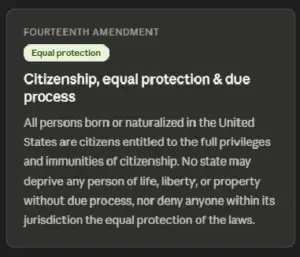
“All persons born or naturalized in the United States, and subject to the jurisdiction thereof, are citizens of the United States and of the State wherein they reside. No State shall make or enforce any law which shall abridge the privileges or immunities of citizens of the United States; nor shall any State deprive any person of life, liberty, or property, without due process of law; nor deny to any person within its jurisdiction the equal protection of the laws.”
Ratified in 1868 in the aftermath of the Civil War, the Fourteenth Amendment fundamentally reshaped the relationship between Americans and their government. It extended citizenship to all persons born on U.S. soil, overturned the Dred Scott decision, and established two principles — due process and equal protection — that have become the legal foundation for nearly every major civil rights expansion in American history.
Citizenship Rights
The Fourteenth Amendment established birthright citizenship — if you are born on U.S. soil, you are a citizen, regardless of the status of your parents. It also established that anyone naturalized as a citizen has the same constitutional protections as those born here.
Due Process — The Government Must Be Fair
The Fourteenth Amendment’s due process clause applies to state governments (the Fifth Amendment applies to the federal government), ensuring that no state can arbitrarily deprive you of life, liberty, or property without fair legal proceedings.
Courts have interpreted due process to include two dimensions:
Procedural Due Process — The government must follow fair procedures. You must receive notice and an opportunity to be heard before the state takes significant action against you.
Substantive Due Process — Certain fundamental rights are so essential that the government cannot infringe on them at all, regardless of the procedure followed. The right to marry, the right to raise your children, and privacy rights have all been grounded in substantive due process.
Equal Protection — No One Is Above the Law, and No One Is Beneath It
The equal protection clause prohibits states from treating similarly situated people differently based on characteristics like race, national origin, or sex without sufficient justification. This clause was the legal backbone of:
- Brown v. Board of Education (1954) — striking down racial segregation in public schools
- Loving v. Virginia (1967) — striking down laws banning interracial marriage
- Reed v. Reed (1971) — first Supreme Court ruling to strike down sex discrimination under equal protection
- Numerous voting rights cases protecting equal access to the ballot
Equal protection does not mean all laws must treat everyone identically. It means the government must have a legitimate reason for treating groups differently, and the more fundamental the right affected, the stronger that justification must be.
The Fourteenth Amendment and Police Encounters
The Fourteenth Amendment is directly relevant when it comes to law enforcement interactions — particularly for communities that have historically faced disparate treatment.
- Racial profiling violates the equal protection clause. Being stopped, searched, or detained based on race rather than individualized suspicion is unconstitutional.
- You have the right to equal treatment regardless of race, national origin, or religion.
- Section 1983 Civil Rights Claims — The Fourteenth Amendment, combined with federal civil rights law (42 U.S.C. § 1983), provides a legal avenue to sue government officials who violate your constitutional rights under color of law.
If you believe your constitutional rights have been violated during a police encounter, document everything — the time, location, officer names or badge numbers, and any witnesses — and consult a civil rights attorney.
Common Misconceptions
“Equal protection means everyone is treated exactly the same.” The law allows for distinctions — it just requires those distinctions to be justified. Age restrictions, licensing requirements, and many other classifications are permissible under equal protection.
“Only minorities can invoke equal protection.” Equal protection applies to all persons within U.S. jurisdiction, regardless of race, background, or identity.
Know Your Rights — In Your Hands, Wherever You Go
The Fourteenth Amendment is the broadest civil rights protection in the Constitution, and it belongs in your pocket. Our Know Your Rights Card Set and Visor Placards summarize all six key amendments in plain language — because knowing your rights is the first step to protecting them.
[Shop the Know Your Rights Card Set →]
[Find a Civil Rights Attorney in Your State →]
The information on this page is provided for educational purposes only and does not constitute legal advice. If you believe your rights have been violated, consult a qualified attorney in your state.
The Fourteenth Amendment: Equal Protection, Due Process & the Rights of All Persons
The Fourteenth Amendment is the most consequential addition to the Constitution since the original Bill of Rights. Ratified in 1868 in the aftermath of the Civil War, it transformed the relationship between the federal government, state governments, and individual Americans in ways that continue to shape every area of constitutional law.
Without the Fourteenth Amendment, the rights protected by the First, Second, Fourth, Fifth, and Sixth Amendments would only restrain the federal government. State governments could — and did — violate them freely. The Fourteenth Amendment changed that. It is the reason your state and local police must respect your Fourth Amendment rights, the reason state courts must provide Sixth Amendment protections, and the reason no state can deny any person the equal protection of the law.
What the Fourteenth Amendment Actually Says
“All persons born or naturalized in the United States, and subject to the jurisdiction thereof, are citizens of the United States and of the State wherein they reside. No State shall make or enforce any law which shall abridge the privileges or immunities of citizens of the United States; nor shall any State deprive any person of life, liberty, or property, without due process of law; nor shall any State deny to any person within its jurisdiction the equal protection of the laws.”
— U.S. Constitution, Amendment XIV, Section 1
Plain-Language Summary
Section 1 of the Fourteenth Amendment does four things:
- Defines citizenship — Everyone born or naturalized in the United States is a citizen, both of the nation and of their state
- Privileges or Immunities Clause — No state can abridge the privileges or immunities of U.S. citizens (limited in scope by early court decisions)
- Due Process Clause — No state can deprive any person of life, liberty, or property without due process of law
- Equal Protection Clause — No state can deny any person the equal protection of the laws
The amendment also contains provisions empowering Congress to enforce these rights by legislation (Section 5) and addressing representation and public debt — but Section 1 is where the constitutional rubber meets the road for everyday Americans.
The Incorporation Doctrine: How the Bill of Rights Applies to Your State
This is the Fourteenth Amendment’s most far-reaching legacy and the concept that connects it to every other page on this site.
When the Bill of Rights was ratified in 1791, it was understood to restrain only the federal government. State governments could pass laws restricting speech, conducting warrantless searches, or denying jury trials — and the Bill of Rights provided no remedy.
The Fourteenth Amendment’s Due Process Clause changed this through a doctrine called selective incorporation. Under this doctrine, the Supreme Court has — case by case, right by right — held that most provisions of the Bill of Rights are “incorporated” against the states, meaning states must respect them just as the federal government must.
What Has Been Incorporated
Virtually the entire Bill of Rights has now been incorporated against the states:
| Right | Amendment | Key Incorporation Case |
|---|---|---|
| Freedom of speech | 1st | Gitlow v. New York (1925) |
| Freedom of religion | 1st | Cantwell v. Connecticut (1940) |
| Freedom of the press | 1st | Near v. Minnesota (1931) |
| Right to bear arms | 2nd | McDonald v. City of Chicago (2010) |
| Protection from unreasonable searches | 4th | Mapp v. Ohio (1961) |
| Right against self-incrimination | 5th | Malloy v. Hogan (1964) |
| Right to a speedy trial | 6th | Klopfer v. North Carolina (1967) |
| Right to counsel | 6th | Gideon v. Wainwright (1963) |
| Right to a jury trial | 6th | Duncan v. Louisiana (1968) |
| Protection from cruel and unusual punishment | 8th | Robinson v. California (1962) |
The practical meaning: when a state trooper stops your car, your Fourth Amendment rights apply. When a state court tries you for a crime, your Sixth Amendment rights apply. When a state legislature passes a law restricting speech, the First Amendment applies. The Fourteenth Amendment is the bridge that makes all of this possible.
The Equal Protection Clause
“No State shall deny to any person within its jurisdiction the equal protection of the laws.”
The Equal Protection Clause requires that government treat similarly situated people similarly. It does not mean the government must treat everyone identically — it means that classifications and distinctions must have sufficient legal justification.
Levels of Scrutiny
Courts apply different standards of review depending on what kind of classification is at issue. This is called the tiers of scrutiny framework.
Strict Scrutiny — Applied to classifications based on race, national origin, and alienage, and to laws that burden fundamental rights. The government must show the law is necessary to achieve a compelling government interest and is narrowly tailored to achieve it. Most laws subjected to strict scrutiny are struck down.
Intermediate Scrutiny — Applied to classifications based on sex and legitimacy. The government must show the law is substantially related to an important government interest. Some laws survive, some do not.
Rational Basis Review — Applied to most other classifications — age, disability, economic regulation, and so on. The government only needs to show the law is rationally related to a legitimate government interest. Laws almost always survive rational basis review.
Race and Equal Protection
The Equal Protection Clause was primarily enacted to protect formerly enslaved people and ensure racial equality. Its history in this regard has been uneven — Plessy v. Ferguson (1896) infamously upheld racial segregation under a “separate but equal” doctrine that stood for nearly sixty years until Brown v. Board of Education (1954) overruled it.
Today, any racial classification by government — including affirmative action programs — is subject to strict scrutiny. In Students for Fair Admissions v. Harvard (2023), the Supreme Court struck down race-conscious admissions programs at Harvard and the University of North Carolina, holding they violated the Equal Protection Clause.
Sex-Based Classifications
Government classifications based on sex are subject to intermediate scrutiny. In United States v. Virginia (1996), the Supreme Court struck down the Virginia Military Institute’s male-only admissions policy, holding that the government must provide an “exceedingly persuasive justification” for sex-based distinctions.
Sexual Orientation and the Equal Protection Clause
The Supreme Court has applied the Equal Protection Clause to protect the rights of LGBTQ+ individuals, though it has not definitively established which tier of scrutiny applies to sexual orientation classifications. In Obergefell v. Hodges (2015), the Court held that same-sex couples have a fundamental right to marry under both the Due Process and Equal Protection Clauses.
The Due Process Clause
“No State shall deprive any person of life, liberty, or property, without due process of law.”
The Fourteenth Amendment’s Due Process Clause parallels the Fifth Amendment’s due process protection but applies it to state governments. Courts have developed two distinct types of due process protection from this clause.
Procedural Due Process
Procedural due process requires that before the government deprives you of life, liberty, or a protected property interest, it must give you fair notice and a meaningful opportunity to be heard.
The core question is: what process is due? The answer depends on what is at stake. The Supreme Court established a balancing test in Mathews v. Eldridge (1976) that weighs:
- The private interest affected
- The risk of erroneous deprivation through current procedures and the value of additional safeguards
- The government’s interest, including administrative and fiscal burdens
The higher the stakes — your liberty, your home, your children — the more process you are owed. A termination of Social Security benefits requires less process than a criminal conviction; a criminal conviction requires more process than a license suspension.
Practical applications:
- Before the government terminates your benefits, it generally must give you notice and a chance to respond
- Before police can seize your property for civil forfeiture, procedural protections apply
- Before the government revokes your professional license, you are entitled to a hearing
- Before a school expels a student, it must provide basic due process
Substantive Due Process
Substantive due process is a more controversial doctrine. It holds that the Due Process Clause protects certain fundamental rights so important that the government cannot infringe on them at all — regardless of how fair the procedures used.
Courts have used substantive due process to protect rights not explicitly listed in the Constitution, including:
- The right to marry (Loving v. Virginia, 1967; Obergefell v. Hodges, 2015)
- The right to use contraception (Griswold v. Connecticut, 1965)
- The right to direct the education of your children (Pierce v. Society of Sisters, 1925)
- The right to live with family members (Moore v. City of East Cleveland, 1977)
Substantive due process is among the most debated doctrines in constitutional law. In Dobbs v. Jackson Women’s Health Organization (2022), the Supreme Court overruled Roe v. Wade and Planned Parenthood v. Casey, holding that the Constitution does not confer a right to abortion and returning the issue to state legislatures. Justice Alito’s majority opinion rejected the substantive due process basis for abortion rights; Justice Thomas’s concurrence argued that other substantive due process precedents, including Griswold and Obergefell, should be reconsidered.
Citizenship Rights
The Fourteenth Amendment’s opening sentence settled the question of birthright citizenship that had been contested since the founding: “All persons born or naturalized in the United States, and subject to the jurisdiction thereof, are citizens of the United States and of the State wherein they reside.”
This was a direct repudiation of Dred Scott v. Sandford (1857), in which the Supreme Court had held that Black Americans could not be citizens. The Fourteenth Amendment made citizenship automatic for anyone born on U.S. soil — a principle that remains in effect and continues to be debated in immigration policy discussions today.
What birthright citizenship means:
- A child born in the United States is a U.S. citizen regardless of the immigration status of their parents
- This citizenship cannot be stripped by Congress through ordinary legislation — it is constitutionally guaranteed
- The phrase “subject to the jurisdiction thereof” excludes children of foreign diplomats with full diplomatic immunity, but courts have consistently held it includes the children of undocumented immigrants
State Action Requirement
The Fourteenth Amendment, like the rest of the Bill of Rights, only restricts government (state) action — not private conduct. A private employer, private school, or private business is not bound by the Fourteenth Amendment’s equal protection or due process requirements.
However, courts have recognized a “state action” doctrine with some nuance — private actors who perform public functions, are heavily regulated by the government, or act in close concert with the government may be subject to constitutional requirements. This doctrine is complex and fact-specific.
This is why a private company can discriminate on bases the Constitution would prohibit for government — though federal and state civil rights statutes fill many of these gaps.
Section 5: Congressional Enforcement Power
Section 5 of the Fourteenth Amendment grants Congress the power to enforce the amendment’s provisions through appropriate legislation. This is the constitutional basis for landmark civil rights legislation including:
- The Civil Rights Act of 1964
- The Voting Rights Act of 1965
- The Americans with Disabilities Act (ADA)
- The Family and Medical Leave Act (FMLA)
Congress’s power under Section 5 must be “congruent and proportional” to the constitutional violation being remedied — it cannot simply use Section 5 to expand rights beyond what the Fourteenth Amendment itself protects (City of Boerne v. Flores, 1997).
Landmark Fourteenth Amendment Cases
Slaughterhouse Cases (1873) — The Supreme Court’s first major interpretation of the Fourteenth Amendment sharply limited the Privileges or Immunities Clause, holding it only protected rights of national citizenship — not the broad individual rights many expected. This narrow reading has largely confined the Privileges or Immunities Clause to historical obscurity.
Plessy v. Ferguson (1896) — Infamously upheld “separate but equal” racial segregation under the Equal Protection Clause. Established the legal foundation for Jim Crow laws for nearly sixty years before being overruled.
Brown v. Board of Education (1954) — Overruled Plessy and held that racially segregated public schools were inherently unequal, violating the Equal Protection Clause. One of the most consequential Supreme Court decisions in American history.
Loving v. Virginia (1967) — Struck down Virginia’s law prohibiting interracial marriage as a violation of both the Equal Protection and Due Process Clauses. “The freedom to marry has long been recognized as one of the vital personal rights essential to the orderly pursuit of happiness by free men.”
Mathews v. Eldridge (1976) — Established the three-factor balancing test for procedural due process: the private interest at stake, the risk of erroneous deprivation, and the government’s interest.
Mapp v. Ohio (1961) — Incorporated the Fourth Amendment’s exclusionary rule against state governments — evidence obtained through unconstitutional searches cannot be used in state criminal trials.
Gideon v. Wainwright (1963) — Incorporated the Sixth Amendment right to counsel against state governments — states must provide appointed attorneys to defendants who cannot afford one.
McDonald v. City of Chicago (2010) — Incorporated the Second Amendment right to keep and bear arms against state and local governments.
United States v. Virginia (1996) — Struck down the Virginia Military Institute’s male-only admissions policy under intermediate scrutiny of sex-based classifications.
Obergefell v. Hodges (2015) — Held that same-sex couples have a fundamental right to marry under both the Due Process and Equal Protection Clauses of the Fourteenth Amendment.
Dobbs v. Jackson Women’s Health Organization (2022) — Overruled Roe v. Wade and Planned Parenthood v. Casey, holding that the Constitution does not protect a right to abortion. Returned abortion regulation to state legislatures. Significant for its treatment of substantive due process.
Students for Fair Admissions v. Harvard (2023) — Struck down race-conscious admissions programs at Harvard and UNC under the Equal Protection Clause, holding that racial classifications in admissions cannot be justified under strict scrutiny.
Real-World Scenarios
“A state law seems to discriminate against people of my race.”
Racial classifications by government — whether federal, state, or local — are subject to strict scrutiny under the Equal Protection Clause. This is the highest standard of judicial review and most laws that discriminate on the basis of race are struck down. If you believe you have been subjected to racial discrimination by a government entity, consult a civil rights attorney about potential claims under the Equal Protection Clause and federal civil rights statutes.
“A government agency is trying to take away my benefits or license without a hearing.”
You likely have procedural due process rights. Before the government deprives you of a protected property or liberty interest, it must provide you with notice and a meaningful opportunity to be heard. The amount of process required depends on the stakes. Request a hearing in writing, document everything, and consult an attorney if the agency refuses.
“My child was denied equal educational opportunities by our public school district.”
Public schools are government actors subject to the Fourteenth Amendment’s Equal Protection Clause. Discrimination in educational programs based on race, sex, disability, or other protected characteristics may violate both the Constitution and federal statutes. Contact a civil rights attorney or the Department of Education’s Office for Civil Rights.
“I was arrested by a local police officer who violated my Fourth Amendment rights.”
The Fourth Amendment applies to state and local police through the Fourteenth Amendment’s incorporation doctrine. Any evidence obtained through an unconstitutional search may be suppressed. Consult a criminal defense attorney immediately to assess whether your rights were violated and whether a motion to suppress is appropriate.
“A state law treats me differently from others without a good reason.”
Whether this violates the Equal Protection Clause depends on what classification is being used and what tier of scrutiny applies. Laws treating people differently based on race, national origin, or fundamental rights face strict scrutiny. Sex-based distinctions face intermediate scrutiny. Other distinctions face rational basis review, which laws almost always survive. A civil rights attorney can evaluate whether you have a viable equal protection claim.
Frequently Asked Questions
Q: What does the 14th Amendment do? The Fourteenth Amendment does three core things: it defines and guarantees citizenship for everyone born or naturalized in the United States; it prohibits states from denying due process of law to any person; and it prohibits states from denying any person equal protection of the laws. It also incorporates most of the Bill of Rights against state governments through its Due Process Clause.
Q: What is the incorporation doctrine? The incorporation doctrine is the legal principle by which the Fourteenth Amendment’s Due Process Clause makes most Bill of Rights protections applicable to state and local governments. Without incorporation, the First, Fourth, Fifth, and Sixth Amendments would only restrict the federal government — not your state police, state courts, or local officials.
Q: What is equal protection under the law? Equal protection means the government must treat similarly situated people similarly and cannot discriminate without sufficient legal justification. The level of justification required depends on the classification: laws based on race require the government to show a compelling interest (strict scrutiny); sex-based laws require an important interest (intermediate scrutiny); most other laws only require a rational basis.
Q: What is due process? Due process means the government cannot deprive you of life, liberty, or property without fair procedures (procedural due process) and cannot infringe on certain fundamental rights at all regardless of procedures (substantive due process). Procedural due process requires notice and an opportunity to be heard. Substantive due process protects fundamental rights like marriage and family decisions from government interference.
Q: Does the 14th Amendment apply to private companies? No. The Fourteenth Amendment only restricts government (state) action — not private employers, businesses, or individuals. A private company can discriminate in ways the government cannot. However, federal and state civil rights statutes often prohibit private discrimination independently of the Constitution.
Q: What is birthright citizenship? Birthright citizenship means that any person born on U.S. soil is automatically a U.S. citizen, regardless of the immigration status of their parents. This is guaranteed by the Fourteenth Amendment’s opening sentence and cannot be changed by ordinary legislation — it would require a constitutional amendment.
Q: How does the 14th Amendment connect to other amendments? The Fourteenth Amendment is the bridge that applies the Bill of Rights to state governments. Through the incorporation doctrine, it ensures that state and local governments must respect your First Amendment free speech rights, Fourth Amendment search and seizure protections, Fifth Amendment self-incrimination rights, and Sixth Amendment trial rights — among others. Every amendment page on this site connects back to the Fourteenth.
Q: What is strict scrutiny? Strict scrutiny is the highest level of judicial review courts apply to government classifications. It is used when the government discriminates based on race, national origin, or alienage, or when it burdens a fundamental right. The government must show the law is necessary to serve a compelling interest and is narrowly tailored. Most laws subjected to strict scrutiny are struck down.
Q: What happened to abortion rights under the 14th Amendment? In Dobbs v. Jackson Women’s Health Organization (2022), the Supreme Court overruled Roe v. Wade and Planned Parenthood v. Casey, holding that the Constitution — including the Fourteenth Amendment’s Due Process Clause — does not protect a right to abortion. The authority to regulate abortion has been returned to state legislatures, resulting in widely varying laws across states.
Q: What is the difference between procedural and substantive due process? Procedural due process requires fair procedures before the government deprives you of life, liberty, or property — notice and an opportunity to be heard. Substantive due process is different: it holds that certain fundamental rights are so important that the government cannot infringe on them at all, regardless of procedures. Marriage, family decisions, and contraception have been protected under substantive due process.
How the Fourteenth Amendment Connects to Every Right on This Site
The Fourteenth Amendment is the reason every other page on CivicGuardLaw.com matters for your everyday life:
- First Amendment — State and local governments cannot restrict your speech, religion, or right to assemble. Incorporated via the 14th.
- Second Amendment — State and local governments cannot ban handguns for law-abiding citizens. Incorporated in McDonald v. City of Chicago (2010).
- Fourth Amendment — State and local police must respect your search and seizure rights. Incorporated in Mapp v. Ohio (1961).
- Fifth Amendment — State governments cannot compel self-incrimination or deny due process. Incorporated via the 14th.
- Sixth Amendment — State courts must provide you a lawyer, a speedy trial, and the right to confront witnesses. Incorporated via the 14th.
The Fourteenth Amendment is not just another amendment. It is the amendment that makes all the others real.
[Shop the Know Your Rights Card Set →]
[Find a Civil Rights Attorney in Your State →]
Disclaimer
The information on this page is educational and does not constitute legal advice. Constitutional law is complex and evolving — particularly in areas like substantive due process and equal protection. If you believe your constitutional rights have been violated by a government entity, consult a licensed civil rights attorney in your jurisdiction.
