
6th AMENDMENT
CONSTITUTIONAL RIGHT
-
Download FREE PDF Format - Your Rights! (Click Link)
- SIXTH AMENDMENT
What Are My 6th Amendment Rights to a Fair Trial and Legal Representation…
FAQ’s Bottom of Page…
SIXTH AMENDMENT
Fair Trial & The Right to Legal Representation
“In all criminal prosecutions, the accused shall enjoy the right to a speedy and public trial, by an impartial jury of the State and district wherein the crime shall have been committed… and to be informed of the nature and cause of the accusation; to be confronted with the witnesses against him; to have compulsory process for obtaining witnesses in his favor, and to have the Assistance of Counsel for his defence.”
If you are ever charged with a crime — whether a misdemeanor or a felony — the Sixth Amendment is the set of rights that governs how that process must unfold. It ensures the government cannot railroad you through a secretive, biased, or indefinitely delayed process. It is the right to a fighting chance.
The Right to a Speedy and Public Trial
The government cannot hold you indefinitely without bringing charges or taking you to trial. “Speedy” is not a precise timeframe — courts weigh factors including the length of the delay, the reason for it, whether you asserted your right, and whether you were prejudiced by the delay.
A public trial means proceedings cannot be held in secret. Transparency is a check against government misconduct and judicial abuse.
The Right to an Impartial Jury
You have the right to have your guilt or innocence determined by a jury of your peers — not just a judge — for serious criminal charges. Jurors must be impartial, meaning neither prosecution nor defense can seat jurors who are obviously biased.
This is why the jury selection process (voir dire) exists, and why both sides have the ability to challenge potential jurors.
The Right to Know the Charges Against You
You must be clearly informed of what you are accused of, in enough detail to prepare a defense. Vague or shifting charges are a violation of this right. You cannot defend yourself against accusations you don’t know about.
The Right to Confront Witnesses
You have the right to face your accusers. This means witnesses who testify against you in court must do so in person (with limited exceptions), and your attorney has the right to cross-examine them. You cannot be convicted based solely on out-of-court statements you had no opportunity to challenge.
The Right to an Attorney — One of Your Most Important Rights
Perhaps the most critical component of the Sixth Amendment is the right to counsel. This means:
- You have the right to be represented by an attorney in any criminal proceeding that could result in imprisonment.
- If you cannot afford an attorney, one will be appointed for you. The Supreme Court established this in Gideon v. Wainwright (1963), one of the most important rulings in American legal history.
- Your right to counsel attaches at critical stages of the prosecution — not just at trial, but during police lineups, preliminary hearings, and other key proceedings.
If you are ever questioned by police in connection with a crime, the most important thing you can do is request an attorney immediately and say nothing else. Once you invoke your right to counsel, questioning must stop.
What to Say If You Are Arrested
- “I am invoking my right to remain silent.”
- “I want an attorney. I will not answer questions without one present.”
Repeat this as needed. Do not engage in small talk with officers while waiting. Do not try to explain your way out of the situation. Wait for your attorney.
Know Your Rights — In Your Hands, Wherever You Go
Understanding the Sixth Amendment before you ever need it is the best legal preparation you can make. Our Know Your Rights Cards and Visor Placards summarize your rights clearly so you can stay calm and informed in any situation.
[Shop the Know Your Rights Card Set →]
[Find a Civil Rights Attorney in Your State →]
The information on this page is provided for educational purposes only and does not constitute legal advice. If you believe your rights have been violated, consult a qualified attorney in your state.
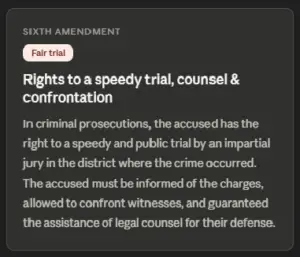
The Sixth Amendment: Your Right to a Fair Trial and Legal Representation
If you are ever accused of a crime, the Sixth Amendment is the amendment that stands between you and the full weight of the government’s prosecutorial power. It does not just give you a lawyer — it gives you a package of rights designed to ensure that any criminal conviction is the product of a fair, transparent, and adversarial process rather than a one-sided proceeding stacked against you.
What the Sixth Amendment Actually Says
“In all criminal prosecutions, the accused shall enjoy the right to a speedy and public trial, by an impartial jury of the State and district wherein the crime shall have been committed, which district shall have been previously ascertained by law, and to be informed of the nature and cause of the accusation; to be confronted with the witnesses against him; to have compulsory process for obtaining witnesses in his favor, and to have the Assistance of Counsel for his defence.”
— U.S. Constitution, Amendment VI
Plain-Language Summary
The Sixth Amendment packs six distinct rights into one sentence:
- Speedy trial — You cannot be left in legal limbo indefinitely
- Public trial — Your proceedings must be open to the public, not conducted in secret
- Impartial jury — You have the right to be judged by unbiased peers
- Notice of charges — You must be told exactly what you are accused of
- Confrontation of witnesses — You have the right to face and cross-examine those who testify against you
- Right to counsel — You have the right to an attorney, and if you cannot afford one, the government must provide one
Every one of these rights applies at every critical stage of a criminal prosecution — from arraignment through trial.
The Right to an Attorney
The most widely known Sixth Amendment right is the right to counsel. In Gideon v. Wainwright (1963), the Supreme Court unanimously held that the Sixth Amendment’s right to counsel is fundamental and is applied to state criminal proceedings through the Fourteenth Amendment. Every person charged with a serious crime — regardless of their ability to pay — has the right to a lawyer.
When the Right Attaches
The right to counsel attaches at the beginning of formal criminal proceedings — meaning after charges are filed, at arraignment, at preliminary hearings, during trial, and at sentencing. It also applies to the first appeal of right after conviction.
The right does not attach to the pre-arrest investigation phase (that is where your Fifth Amendment rights come into play), or to most post-conviction proceedings.
Court-Appointed Attorneys
If you cannot afford to hire a private attorney, the court must appoint one for you at no cost. In most jurisdictions, this means a public defender — a licensed attorney employed by the government specifically to represent indigent defendants.
Public defenders are often highly skilled and experienced attorneys. However, many public defender offices are significantly underfunded and carry extremely heavy caseloads. This is a structural problem that affects the quality of representation available to many defendants.
Effective Assistance of Counsel
Having an attorney is not enough — the Sixth Amendment requires effective assistance of counsel. In Strickland v. Washington (1984), the Supreme Court established a two-part test for ineffective assistance claims:
- The attorney’s performance fell below an objective standard of reasonableness (deficient performance)
- There is a reasonable probability that, but for the attorney’s errors, the result would have been different (prejudice)
This is a high bar to clear. Courts presume that an attorney’s conduct falls within the wide range of reasonable professional conduct, and many claims of ineffective assistance fail even when significant errors occurred.
The Right to Represent Yourself
The Sixth Amendment also protects the right to waive counsel and represent yourself — called appearing pro se. Courts will typically warn defendants of the risks of self-representation and ensure the waiver is knowing, voluntary, and intelligent. Self-representation is almost always inadvisable in serious criminal cases.
Invoking Your Right to Counsel
The single most important thing to know: ask for a lawyer immediately and clearly. Once you invoke your right to counsel, police must stop questioning you until an attorney is present.
Say: “I am invoking my right to an attorney. I will not answer any questions until my attorney is present.”
Do not hedge, qualify, or ask questions like “Maybe I should talk to a lawyer?” Courts have held that ambiguous requests for counsel do not trigger the right. Be direct and unequivocal.
The Right to a Speedy Trial
The Sixth Amendment guarantees that you will not be left waiting indefinitely while criminal charges hang over your head. Prolonged pre-trial detention harms defendants — witnesses’ memories fade, evidence becomes harder to gather, and the accused may be imprisoned for extended periods before any verdict is reached.
The Barker v. Wingo Balancing Test
The Supreme Court established a four-factor balancing test in Barker v. Wingo (1972) to determine whether a speedy trial violation has occurred:
- Length of delay — How long was the delay? A delay of less than a year is rarely presumptively prejudicial. Delays of several years raise serious concerns.
- Reason for the delay — Was the delay caused by the government, the defendant, or neutral factors like court congestion?
- Defendant’s assertion of the right — Did the defendant timely demand a speedy trial?
- Prejudice to the defendant — Did the delay actually harm the defendant — through oppressive pre-trial incarceration, anxiety, or impairment of the defense?
The Remedy for Speedy Trial Violations
Unlike most constitutional violations, a speedy trial violation carries a severe and automatic remedy: dismissal of the charges with prejudice. This means the government cannot re-prosecute. This drastic remedy is why courts apply the Barker test carefully — not every delay constitutes a constitutional violation.
Statutory Speedy Trial Rights
In addition to the constitutional right, most jurisdictions have speedy trial statutes that set specific timeframes — often 70 days for federal prosecutions under the Speedy Trial Act, or varying periods under state law. These statutory rights are often more easily enforced than the constitutional standard.
The Right to a Public Trial
Criminal proceedings must be open to the public. Secret trials are a hallmark of authoritarian regimes — the public trial requirement ensures government accountability and gives the accused the protection of public scrutiny.
Courts can close proceedings in rare circumstances — to protect witness safety, preserve juror impartiality in high-profile cases, or protect classified information — but closures must be justified by compelling interests and limited to what is strictly necessary.
The press has a related First Amendment right of access to criminal proceedings, reinforcing the public trial guarantee.
The Right to an Impartial Jury
In serious criminal cases, you have the right to be tried by a jury of your peers rather than by a judge alone (though you can waive this right and elect a bench trial).
Jury Selection: Voir Dire
Jurors are selected through a process called voir dire — questioning by attorneys and the judge to identify bias. Both the prosecution and defense can challenge prospective jurors in two ways:
For cause challenges — Unlimited in number. Used to remove jurors who demonstrate actual bias or who cannot be fair.
Peremptory challenges — Limited in number (varies by jurisdiction). Used to remove jurors without stating a reason — but cannot be used to exclude jurors based on race (Batson v. Kentucky, 1986) or sex (J.E.B. v. Alabama, 1994).
Size and Unanimity
Federal criminal juries consist of 12 jurors and must reach a unanimous verdict. State jury requirements vary — some states have allowed non-unanimous verdicts in certain cases, though the Supreme Court held in Ramos v. Louisiana (2020) that the Sixth Amendment requires unanimous jury verdicts in serious criminal cases.
The Right to Be Informed of Charges
Before trial, you have the right to know specifically what crime you are accused of committing. This is not just a technical requirement — it serves two critical functions:
- It allows you and your attorney to prepare an effective defense
- It protects against double jeopardy by clearly defining what you were tried for
Charges must be specific enough to give genuine notice. A charge that merely recites the statutory language without specifying the alleged conduct may be constitutionally deficient.
The Confrontation Clause: Your Right to Face Your Accusers
The Confrontation Clause gives you the right to confront witnesses who testify against you — meaning they must testify in open court, subject to cross-examination, rather than through written statements or hearsay.
Crawford v. Washington and Testimonial Statements
In Crawford v. Washington (2004), the Supreme Court fundamentally changed confrontation clause analysis. The Court held that “testimonial” out-of-court statements — those made in circumstances that would lead an objective person to expect them to be used at trial — cannot be admitted against the defendant unless the witness is available for cross-examination or the defendant had a prior opportunity to cross-examine them.
This means, for example, that a recorded police interview in which a victim describes an assault is “testimonial” and cannot be used at trial unless the victim testifies and is available for cross-examination.
Why Cross-Examination Matters
Cross-examination is the primary tool for testing the reliability of testimony. It allows the defense to challenge a witness’s memory, perception, bias, prior inconsistent statements, and motive to lie. The Confrontation Clause ensures that the jury hears not just the government’s witnesses but also the defense’s challenge to their credibility.
Compulsory Process: Your Right to Call Witnesses
The flipside of the confrontation clause is the compulsory process right — your right to compel witnesses to testify in your favor. The government can subpoena witnesses; so can you. A court can issue a subpoena ordering a witness to appear and testify, and contempt sanctions apply to those who refuse without legal justification.
Landmark Sixth Amendment Cases
Gideon v. Wainwright (1963) — The foundational right to counsel case. The Supreme Court unanimously held that the Sixth Amendment’s right to an attorney applies to state criminal proceedings through the Fourteenth Amendment. Every person charged with a serious crime is entitled to a lawyer, regardless of ability to pay.
Strickland v. Washington (1984) — Established the two-part test for ineffective assistance of counsel claims: deficient performance and resulting prejudice. Set a high but not insurmountable standard for overturning convictions based on poor lawyering.
Barker v. Wingo (1972) — Established the four-factor balancing test for speedy trial violations: length of delay, reason for delay, defendant’s assertion of the right, and prejudice to the defendant.
Crawford v. Washington (2004) — Testimonial out-of-court statements cannot be used against a defendant at trial unless the witness is available for cross-examination. Fundamentally reformed confrontation clause analysis.
Batson v. Kentucky (1986) — Prosecutors cannot use peremptory challenges to exclude jurors based on race. Extended by J.E.B. v. Alabama (1994) to prohibit sex-based exclusions as well.
Ramos v. Louisiana (2020) — The Sixth Amendment requires unanimous jury verdicts in serious criminal cases, overruling prior precedent that had allowed non-unanimous verdicts in some states.
Massiah v. United States (1964) — Once formal proceedings have begun, the government cannot deliberately elicit incriminating statements from a defendant outside the presence of counsel. Undercover informants cannot be used to gather incriminating statements from charged defendants without their attorney present.
Alabama v. Shelton (2002) — The right to counsel applies to any criminal proceeding where the defendant faces the possibility of incarceration — even a suspended sentence. If imprisonment is a potential consequence, a lawyer must be provided.
Real-World Scenarios
“I was arrested and police want to question me.”
The moment you are in custody, your Sixth Amendment right to counsel is active (in addition to your Fifth Amendment right to remain silent). Say clearly: “I am invoking my right to an attorney. I will not answer any questions until my attorney is present.” Police must stop questioning you. Do not wait and see. Do not try to explain yourself first. Invoke immediately.
“I cannot afford a lawyer.”
Tell the court at your first appearance — your arraignment. The judge will ask whether you have an attorney or need one appointed. State clearly that you cannot afford a private attorney and request the appointment of a public defender. This right is absolute. You cannot be denied appointed counsel in a proceeding where incarceration is possible because of financial status.
“My case has been dragging on for over a year with no trial date.”
You may have a speedy trial claim. The key factors are: how long the delay has been, whether your attorney has demanded a speedy trial, and whether the delay has been caused by the government rather than by your own requests for continuances. Talk to your attorney about filing a formal speedy trial demand — this creates a record and is one of the four Barker factors courts weigh.
“A witness who can’t be cross-examined is being used against me at trial.”
This may be a Confrontation Clause violation. Under Crawford v. Washington, testimonial statements from witnesses who do not testify at trial generally cannot be used against you. If the prosecution is trying to introduce recorded statements, police reports of what a witness said, or other out-of-court testimonial statements without producing the witness, your attorney should object and move to exclude the evidence.
“I think my attorney is not adequately representing me.”
Document your concerns specifically — missed deadlines, failure to investigate, not returning calls, failure to file motions you discussed. Raise your concerns with your attorney first. If you believe the representation is genuinely deficient, you can request a new attorney (the court may or may not grant this) or file a bar complaint. After conviction, ineffective assistance of counsel claims can be raised in post-conviction proceedings.
Frequently Asked Questions
Q: Do I have the right to a free lawyer? Yes, if you face the possibility of incarceration and cannot afford a private attorney, the government must appoint one for you at no cost. This right was established in Gideon v. Wainwright (1963) and applies to any criminal proceeding — federal or state — where imprisonment is a possible outcome.
Q: What should I say to invoke my right to an attorney? Say clearly and directly: “I am invoking my right to an attorney. I will not answer any questions until my attorney is present.” Ambiguous requests — “maybe I should get a lawyer” or “do you think I need a lawyer?” — may not trigger the right. Be unequivocal.
Q: What is a speedy trial? The Sixth Amendment guarantees that your trial must occur without unreasonable delay. Courts use a four-factor balancing test — length of delay, reason for delay, whether you demanded a speedy trial, and prejudice to you — to determine whether the right has been violated. If it has, the case must be dismissed with prejudice.
Q: What does the confrontation clause mean? The confrontation clause gives you the right to face and cross-examine witnesses who testify against you at trial. It means the government generally cannot use recorded or written statements from witnesses who do not appear and testify — you have the right to challenge their credibility in open court.
Q: Can charges be dropped because of a speedy trial violation? Yes — and this is one of the only constitutional violations that results in automatic dismissal with prejudice, meaning the government cannot re-prosecute. However, courts apply the balancing test carefully and not every delay rises to a constitutional violation.
Q: What is the right to an impartial jury? You have the right to be tried by jurors who do not have pre-existing bias about your guilt or innocence. Jurors are selected through voir dire questioning, and both sides can challenge jurors for cause (unlimited) or through peremptory strikes (limited). Peremptory strikes cannot be used to exclude jurors based on race or sex.
Q: What does “effective assistance of counsel” mean? It means your attorney must perform at a reasonable level of professional competence and that any failures must not have changed the outcome of your case. It is not enough that your attorney made mistakes — you must show both deficient performance and resulting prejudice. This is a high standard but it can be met in cases of serious attorney neglect or error.
Q: Does the Sixth Amendment apply to misdemeanors? The right to counsel applies to any offense where incarceration is actually imposed. If you are charged with a misdemeanor and the sentence does not include any jail time, the appointed counsel right may not apply. But if imprisonment — even a suspended sentence — is a possible outcome, you are entitled to a lawyer.
Q: What is compulsory process? Compulsory process is your right to subpoena witnesses to testify in your defense. Just as the government can compel witnesses to testify against you, you can compel witnesses to testify for you. Courts can hold witnesses in contempt for refusing to appear without legal justification.
Q: Can I represent myself in a criminal case? Yes. The Supreme Court held in Faretta v. California (1975) that you have a constitutional right to represent yourself if your waiver of counsel is knowing, voluntary, and intelligent. Courts will typically warn you of the risks. Self-representation in serious criminal cases is almost always inadvisable.
Know Your Rights in the Moment
From the moment you are arrested or formally charged, these are the most important words you can say:
- To invoke your right to an attorney: “I am invoking my right to an attorney. I will not answer any questions until my attorney is present.”
- To request appointed counsel: Tell the judge at arraignment: “I cannot afford an attorney and I am requesting that one be appointed for me.”
- To assert your speedy trial right: Ask your attorney to file a formal speedy trial demand early — this protects the record.
Related Amendments
- Fifth Amendment — Works hand-in-hand with the Sixth. When you invoke your right to counsel, also invoke your right to remain silent. Both protect you from self-incrimination during interrogation.
- Fourth Amendment — Protects you from unlawful searches before charges are filed. Evidence gathered illegally cannot be used against you at the trial your Sixth Amendment rights govern.
- Fourteenth Amendment — The incorporation doctrine that applies Sixth Amendment protections to state courts, not just federal proceedings.
Disclaimer
The information on this page is educational and does not constitute legal advice. Criminal law varies significantly by jurisdiction and the facts of individual cases matter enormously. If you are facing criminal charges, consult a licensed attorney immediately.
