
1st AMENDMENT
CONSTITUTIONAL RIGHT
-
Download FREE PDF Format - Your Rights! (Click Link)
- FIRST AMENDMENT
What Are My 1st Amendment Freedom of Expression & Belief Rights – The Foundation of American Freedom…
FAQ’s Bottom of Page…
FIRST AMENDMENT
Freedom of Expression & Belief
“Congress shall make no law respecting an establishment of religion, or prohibiting the free exercise thereof; or abridging the freedom of speech, or of the press; or the right of the people peaceably to assemble, and to petition the Government for a redress of grievances.”
The First Amendment is the cornerstone of American liberty. It protects five fundamental freedoms — religion, speech, press, assembly, and petition — and together they form the foundation that makes every other right possible. Without the freedom to speak, question, and challenge authority, no other right can truly be defended.
What Does the First Amendment Actually Protect?
Many people are surprised to learn how broad — and how limited — First Amendment protections really are. Here’s what you need to know.
Freedom of Speech You have the right to express your opinions, even unpopular or controversial ones, without government punishment. This includes political speech, symbolic speech (like wearing an armband or displaying a flag), and speech that criticizes public officials or government policy. However, free speech is not unlimited. It does not protect threats of violence, incitement to imminent lawless action, fraud, or defamation.
Freedom of Religion The government cannot establish an official religion, force you to practice a religion, or prevent you from practicing your own faith. This applies to public schools, government workplaces, and any government-run institution.
Freedom of the Press Journalists and media outlets are protected from government censorship or prior restraint — meaning the government generally cannot stop a publication before it’s printed. This is why a free press is often called the fourth estate, acting as a watchdog on government power.
Freedom of Peaceful Assembly You have the right to gather with others in public spaces to protest, demonstrate, or organize — as long as it remains peaceful. Law enforcement cannot simply disperse a crowd because they disagree with the message.
Right to Petition You have the right to contact your elected officials, sign petitions, file lawsuits against the government, and seek change through legal channels without fear of retaliation.
Your First Amendment Rights During a Police Encounter
Knowing your rights on paper is one thing. Knowing how to assert them calmly and clearly in the moment is what matters.
- You have the right to remain silent. You are not required to answer questions beyond providing your name in states with stop-and-identify laws. Politely say: “I am exercising my right to remain silent.”
- You have the right to record police in public. Filming law enforcement in a public place is protected First Amendment activity. Do not interfere with their duties, but you do not have to stop recording.
- You have the right to protest in public spaces. Parks, sidewalks, and plazas are traditional public forums. You do not need a permit for small, spontaneous gatherings in most cases.
- Know the limits. First Amendment rights apply to government action — not private companies, employers, or social media platforms.
Common Misconceptions
“I can say anything I want.” Free speech protects you from government punishment — not consequences from employers, schools, or private organizations.
“I can record anywhere.” Recording in public spaces is protected, but private property (including some government buildings) may have different rules.
“Peaceful protest can’t be stopped.” Authorities can impose reasonable time, place, and manner restrictions — just not content-based ones.
Know Your Rights — In Your Hands, Wherever You Go
Don’t rely on memory when it matters most. Our Know Your Rights Card Set includes a dedicated First Amendment card with a plain-language overview on the front and actionable guidance on the back — small enough for your wallet, clear enough for any situation.
[Shop the Know Your Rights Card Set →]
The information on this page is provided for educational purposes only and does not constitute legal advice. If you believe your rights have been violated, consult a qualified attorney in your state.
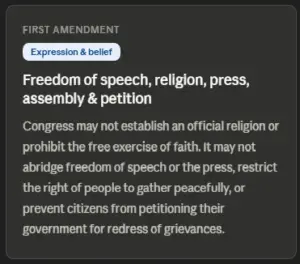
The First Amendment: Freedom of Speech, Religion, Press, Assembly & Petition
The First Amendment is the cornerstone of American liberty. It protects your right to speak your mind, practice your faith, publish your views, gather with others, and demand answers from your government — all without fear of government punishment. No other democracy protects free expression as broadly as the United States does.
But the First Amendment is also one of the most misunderstood protections in the Constitution. It does not mean you can say anything, anywhere, to anyone without consequences. Understanding what it actually protects — and what it does not — is the difference between asserting your rights effectively and misapplying them.
What the First Amendment Actually Says
“Congress shall make no law respecting an establishment of religion, or prohibiting the free exercise thereof; or abridging the freedom of speech, or of the press; or the right of the people peaceably to assemble, and to petition the Government for a redress of grievances.”
— U.S. Constitution, Amendment I
Plain-Language Summary
One sentence. Five freedoms:
- Freedom of religion — The government cannot establish an official religion or prevent you from practicing your own
- Freedom of speech — The government cannot punish you for most forms of expression
- Freedom of the press — The government cannot censor or control the media
- Freedom of assembly — You have the right to gather peacefully with others
- Freedom of petition — You have the right to ask the government to fix problems
The single most important thing to understand: the First Amendment only restricts government action. It does not apply to private individuals, private employers, or private platforms.
The Critical Limit: Government Action Only
The First Amendment says “Congress shall make no law” — and courts have extended this to all levels of government. But it has never applied to private actors.
This means:
- Your employer can fire you for what you say (with very limited exceptions)
- Facebook, Twitter/X, YouTube, and other private platforms can remove your content or ban your account
- A private business can ask you to leave for speech they find objectionable
- Your neighbors can object to your signs
None of these are First Amendment violations. The First Amendment only protects you from government censorship and punishment — not from private consequences.
Freedom of Speech: What Is (and Is Not) Protected
What the First Amendment Protects
The First Amendment protects a vast range of expression, including much that is offensive, provocative, or deeply unpopular. Courts have held that protecting unpopular speech is precisely the point — popular speech rarely needs protection.
Protected categories include:
Political speech — The most strongly protected category. Criticism of government, politicians, and public policy is at the core of the First Amendment. The government cannot punish you for your political views.
Symbolic speech — Actions that communicate a message. Flag burning (Texas v. Johnson, 1989), wearing armbands (Tinker v. Des Moines, 1969), and other expressive conduct are protected.
Offensive and hateful speech — With very limited exceptions, the First Amendment protects speech that is deeply offensive, including hate speech. The Supreme Court has consistently rejected broad hate speech exceptions to the First Amendment (Matal v. Tam, 2017; Snyder v. Phelps, 2011).
Anonymous speech — The right to speak anonymously is protected (McIntyre v. Ohio Elections Commission, 1995). You generally cannot be compelled to identify yourself as the author of a pamphlet or online post.
Commercial speech — Advertising and commercial expression receive First Amendment protection, though the government can regulate misleading commercial speech more freely than other speech.
What the First Amendment Does NOT Protect
Courts have recognized specific categories of speech that fall outside First Amendment protection. These are narrow and well-defined — the government cannot simply label speech “harmful” and suppress it.
True threats — Statements that communicate a serious intent to commit violence against a specific person or group. The threat must be genuine, not merely offensive or hyperbolic.
Incitement to imminent lawless action — Speech that is directed to producing imminent lawless action and is likely to produce such action (Brandenburg v. Ohio, 1969). This is a high standard — abstract advocacy of illegal conduct is protected; direct incitement to immediate violence is not.
Obscenity — Sexually explicit material that meets the three-part Miller v. California (1973) test: appeals to prurient interest, depicts sexual conduct in a patently offensive way, and lacks serious literary, artistic, political, or scientific value.
Defamation — False statements of fact that damage someone’s reputation. Public figures must prove “actual malice” — knowledge of falsity or reckless disregard for the truth (New York Times v. Sullivan, 1964).
Fraud and perjury — False statements made to deceive or under oath are not protected.
“Fighting words” — Face-to-face personal insults that are so provocative they are likely to cause an immediate breach of the peace (Chaplinsky v. New Hampshire, 1942). This category has been extremely narrowly applied by modern courts.
Child pornography — Completely unprotected and subject to criminal prosecution.
Freedom of Religion: Two Clauses, One Protection
The First Amendment addresses religion through two clauses that work together.
The Establishment Clause
“Congress shall make no law respecting an establishment of religion.”
The government cannot establish an official religion, favor one religion over another, or favor religion over non-religion (or vice versa) in most contexts. This is the basis for the separation of church and state.
Key applications:
- Public schools cannot lead students in prayer or teach religious doctrine as fact
- Government buildings generally cannot display exclusively religious symbols
- Government funding of religious organizations is permitted only under specific conditions
The Free Exercise Clause
“…or prohibiting the free exercise thereof.”
The government cannot prevent you from practicing your religion or punish you for your religious beliefs. However, religiously motivated conduct can be regulated if the law is neutral and generally applicable — meaning it applies to everyone, not just religious practitioners.
Employment Division v. Smith (1990) — A neutral, generally applicable law does not violate the Free Exercise Clause even if it burdens religious practice. This case significantly narrowed free exercise protections, and Congress responded with the Religious Freedom Restoration Act (RFRA).
Fulton v. City of Philadelphia (2021) — The government cannot enforce a non-discrimination requirement against a religious organization when it allows exceptions for secular organizations, as this is not a neutral, generally applicable law.
Freedom of the Press
The First Amendment gives the press powerful protections against government censorship. The government cannot stop a publication before it is published — this is called the “prior restraint” doctrine, and it is almost never permitted (New York Times Co. v. United States, 1971 — the Pentagon Papers case).
Reporters also have some protection for their sources, though this varies by state. Many states have “shield laws” protecting journalists from being compelled to reveal confidential sources. There is no absolute federal reporter’s privilege, but courts balance the government’s need for information against press freedom interests.
Freedom of the press protects not just professional journalists but anyone engaged in journalism — including bloggers and citizen journalists.
Freedom of Assembly: Your Right to Protest
You have the right to gather peacefully with others, including for protests, demonstrations, and marches.
What “Peaceable” Means
The First Amendment protects peaceful assembly. Violence, property destruction, and unlawful obstruction of roads or buildings are not protected simply because they occur alongside a protest. Police can lawfully disperse assemblies that turn violent or block traffic without permits.
Permits and Time-Place-Manner Restrictions
The government can regulate the time, place, and manner of assemblies — but it cannot do so based on the content or viewpoint of the speech. A city can require permits for large parades (a content-neutral rule), but it cannot deny a permit because it disagrees with the protest’s message.
Permit requirements must be content-neutral, narrowly tailored, leave open alternative channels of communication, and not give officials unbridled discretion to approve or deny.
Your Rights at a Protest
- You can photograph and record police and government officials performing their duties in public
- You can counter-protest, but not in a way that physically disrupts another group’s lawful assembly
- Police can order dispersal of an assembly that has become unlawful — but they must give clear warning and a reasonable opportunity to comply
- You do not have to answer police questions at a protest beyond identifying yourself if required by state law
Recording Police: A First Amendment Right
Courts across the United States have consistently held that recording police officers performing their duties in public places is protected by the First Amendment. You have the right to film, photograph, and record police activity in public — openly or discreetly.
What you can do:
- Film police making arrests in public
- Record traffic stops from a lawful vantage point
- Photograph police activity on public streets and sidewalks
What officers cannot do:
- Order you to stop recording without legal justification
- Seize or delete your recordings without a warrant
- Arrest you for recording alone (absent genuine obstruction)
Practical guidance:
- Do not physically interfere with the officers’ work — stay at a safe distance
- If an officer orders you to move back, comply while continuing to record
- Clearly state: “I am exercising my First Amendment right to record police activity in public.”
- If an officer demands your phone, say: “I do not consent to a search of my device.”
Your existing post — Is It Legal to Record Police Officers? — covers this topic in depth.
The First Amendment in Schools
Student speech rights exist but are more limited than adult rights in public spaces.
Public school students retain First Amendment rights — they do not “shed their constitutional rights at the schoolhouse gate” (Tinker v. Des Moines, 1969). But schools can regulate speech that substantially disrupts the educational environment, is vulgar or lewd (Bethel School District v. Fraser, 1986), or occurs in school-sponsored activities (Hazelwood School District v. Kuhlmeier, 1988).
College and university students at public institutions have significantly stronger First Amendment protections than K-12 students. Public universities are government actors and cannot impose viewpoint-based speech restrictions. “Free speech zones” that confine students to small areas have frequently been struck down by courts.
Private schools are not bound by the First Amendment because they are private institutions, though they may have their own policies or contractual obligations regarding student speech.
The First Amendment and Social Media
This is one of the most debated First Amendment questions today.
Private platforms (Facebook, X/Twitter, YouTube, TikTok) are private companies. They can remove content, ban accounts, and moderate speech without violating the First Amendment. The First Amendment does not require private companies to host your speech.
Government officials and social media — This is different. Courts have held that government officials who use social media accounts for official purposes cannot block constituents based on their viewpoint. In Lindke v. Freed (2024), the Supreme Court held that whether a public official’s social media activity is “state action” depends on whether the official was speaking in their governmental capacity.
Government-compelled platform moderation — Courts are actively grappling with whether states can force social media platforms to host certain speech. This area of law is rapidly evolving.
Landmark First Amendment Cases
Schenck v. United States (1919) — The original “clear and present danger” test. Established that speech presenting a clear and present danger of immediate evil could be restricted. The famous “falsely shouting fire in a crowded theater” analogy comes from this case. The standard has since been significantly replaced by Brandenburg.
Tinker v. Des Moines (1969) — Public school students wearing black armbands to protest the Vietnam War were protected. Students do not shed their First Amendment rights at the schoolhouse gate. Student speech can only be restricted if it causes substantial disruption.
Brandenburg v. Ohio (1969) — Overruled earlier “clear and present danger” tests. The government can only prohibit speech that is directed to producing imminent lawless action and is likely to produce such action. Abstract advocacy of illegal conduct is protected.
New York Times v. Sullivan (1964) — Public officials must prove “actual malice” to win a defamation lawsuit. Established robust press protections and set the modern standard for defamation claims by public figures.
New York Times Co. v. United States (1971) — The Pentagon Papers case. The government cannot engage in prior restraint — stopping publication before it happens — without an extraordinarily heavy justification. A free press can publish classified documents if it obtains them lawfully.
Texas v. Johnson (1989) — Flag burning is protected symbolic speech. The government cannot prohibit the expression of an idea simply because society finds it disagreeable.
Snyder v. Phelps (2011) — Westboro Baptist Church’s protests at military funerals, though deeply offensive, were protected speech on matters of public concern occurring in a public place. Even profoundly hurtful speech on public issues is protected.
Matal v. Tam (2017) — The government cannot deny trademark registration based on viewpoint. Reinforced that the government cannot suppress speech simply because it is offensive.
Real-World Scenarios
“I was fired for something I posted on social media.”
This is almost certainly not a First Amendment violation — unless your employer is a government agency. Private employers can set speech-related conduct standards and terminate employees for violating them. Government employees have more protection for speech on matters of public concern, but even this is limited.
“Police told me to stop filming an arrest.”
You have the right to record. Clearly state: “I am exercising my First Amendment right to record police in public.” Do not physically interfere with the officers. If they order you to step back, comply while continuing to record. If they seize your phone or delete footage, this may be a Fourth and First Amendment violation — document the officers’ names and badge numbers.
“My child was punished for something they said at school.”
The key question is whether the speech caused, or could reasonably be expected to cause, substantial disruption to the school environment. If the speech was a political opinion expressed peacefully outside of class, it likely has strong First Amendment protection. If it was threatening or seriously disruptive, the school may have authority to act.
“A city denied our permit to hold a rally.”
Permit denials based on the content or viewpoint of a planned protest are almost certainly unconstitutional. Time, place, and manner restrictions are permitted if they are content-neutral and narrowly tailored. If your permit was denied because of what you planned to say, consult an attorney — this is a strong First Amendment claim.
“I was arrested at a protest.”
Being present at a protest that becomes unlawful does not automatically make you subject to arrest. Police must give clear dispersal orders and a reasonable opportunity to comply. If you were arrested for simply being present, or for constitutionally protected activity, this may be a First Amendment violation.
Frequently Asked Questions
Q: Does the First Amendment protect hate speech? In the United States, hate speech — even speech that is deeply offensive, racist, or bigoted — is generally protected by the First Amendment unless it falls into an unprotected category such as true threats or incitement to imminent violence. The Supreme Court has repeatedly rejected broad hate speech exceptions. This makes U.S. free speech law much broader than that of most other democracies.
Q: Can my employer fire me for what I say? Generally yes, if your employer is a private company. The First Amendment only restricts government action. Private employers can set conduct and speech standards. Government employees have greater protection for speech on matters of public concern, but even that protection has significant limits.
Q: Does the First Amendment protect me on social media? Private social media platforms can remove content and ban users without violating the First Amendment — they are private companies. However, government officials who block constituents on official social media accounts may be violating the First Amendment.
Q: Can I record police in public? Yes. Courts across the country have consistently held that recording police officers performing their duties in public is protected by the First Amendment. Officers cannot order you to stop filming without legal justification, and they cannot seize or delete your recordings without a warrant.
Q: Is flag burning protected speech? Yes. The Supreme Court ruled in Texas v. Johnson (1989) that burning the American flag as a political protest is protected symbolic speech. The government cannot prohibit the expression of an idea simply because society finds it offensive.
Q: What speech is not protected by the First Amendment? The main unprotected categories are: true threats, incitement to imminent lawless action, obscenity, defamation (false statements of fact), fraud, perjury, and child pornography. These categories are narrow and precisely defined — the government cannot simply label speech “harmful” to strip it of protection.
Q: Does the First Amendment apply in schools? For public school students, yes — but with more limitations than adults in public spaces. Schools can restrict speech that substantially disrupts the educational environment. At public colleges and universities, students have much stronger First Amendment protections. Private schools are not bound by the First Amendment.
Q: Can the government stop a newspaper from publishing a story? Almost never. Prior restraint — stopping publication before it happens — is one of the most disfavored actions in First Amendment law. The government must meet an extraordinarily high burden to justify stopping a publication, and courts have rarely allowed it.
Q: What is the difference between the Establishment Clause and the Free Exercise Clause? The Establishment Clause prevents the government from creating or favoring an official religion. The Free Exercise Clause prevents the government from prohibiting the practice of religion. Together, they require the government to stay neutral toward religion — neither promoting nor suppressing it.
Q: Can I protest anywhere I want? You can protest in traditional public forums — streets, sidewalks, and parks — subject to reasonable time, place, and manner restrictions. These restrictions must be content-neutral and cannot give officials discretion to approve or deny based on the protest’s message. You generally cannot protest on private property without the owner’s permission.
Know Your Rights in the Moment
At a protest or demonstration:
- “I am exercising my First Amendment right to peacefully assemble.”
- “I am exercising my First Amendment right to record police activity in public.”
If police order dispersal:
- Comply with the order while documenting everything
- Ask clearly: “Am I free to go?”
If your phone is seized:
- “I do not consent to a search of my device.”
Related Amendments
- Fourth Amendment — Protects you from unreasonable searches during a protest, including demands to search your phone or recording equipment.
- Fifth Amendment — Your right to remain silent applies at protests. You do not have to answer police questions.
- Fourteenth Amendment — The incorporation doctrine applies First Amendment protections against state and local governments, not just the federal government.
[Shop the Know Your Rights Card Set →]
Disclaimer
The information on this page is educational and does not constitute legal advice. First Amendment law is complex and fact-specific. If your speech or assembly rights have been violated, consult a licensed attorney in your jurisdiction.
