
2nd AMENDMENT
CONSTITUTIONAL RIGHT
-
Download FREE PDF Format - Your Rights! (Click Link)
- SECOND AMENDMENT
What Are My 2nd Amendment Understanding the Right to Keep and Bear Arms…
FAQ’s Bottom of Page…
SECOND AMENDMENT
The Right to Keep & Bear Arms
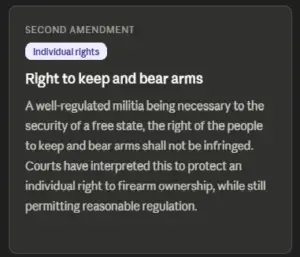
“A well regulated Militia, being necessary to the security of a free State, the right of the people to keep and bear Arms, shall not be infringed.”
Few amendments generate more debate than the Second Amendment — and few are more misunderstood by everyday Americans on both sides of the conversation. Whether you are a gun owner, a concealed carry permit holder, or simply want to understand your constitutional rights, knowing what the Second Amendment actually says and how courts have interpreted it is essential.
What Does the Second Amendment Protect?
In 2008, the Supreme Court ruled in District of Columbia v. Heller that the Second Amendment protects an individual’s right to possess firearms for traditionally lawful purposes — including self-defense within the home — independent of service in a militia. This was a landmark decision that settled decades of debate about whether the right was collective or individual.
In 2010, McDonald v. City of Chicago extended that protection to state and local laws, meaning state governments cannot simply ban gun ownership either.
What this means for you:
- You have the right to own a firearm for self-defense in your home.
- The government cannot impose an outright ban on handguns or commonly used firearms.
- Regulations such as background checks, licensing requirements, and restrictions on certain weapon types have generally been upheld as permissible.
Carrying Firearms — Know Your State’s Laws
The Second Amendment establishes the right, but how that right is exercised in public varies significantly by state. Laws fall into several categories:
Constitutional Carry (Permitless Carry) — A growing number of states allow qualified individuals to carry a concealed firearm without a permit. Requirements vary, so always verify your state’s specific rules.
Shall-Issue States — The government must issue a concealed carry permit if you meet the legal requirements (background check, training, etc.).
May-Issue States — Authorities have discretion over whether to issue a permit, even if you meet baseline requirements.
Open Carry — Some states permit openly carrying a firearm without a permit. Others prohibit it entirely.
Always research the laws of any state you plan to travel through or to — what is legal at home may not be legal elsewhere.
Your Rights During a Traffic Stop as a Gun Owner
If you are legally carrying a firearm during a traffic stop, how you handle the encounter matters.
- Stay calm and keep your hands visible. Do not reach for anything without stating your intentions first.
- Know your state’s disclosure law. Some states require you to immediately inform an officer that you are carrying. Others do not. Know which applies to you before you get pulled over.
- You generally do not have to consent to a search. If an officer asks to search your vehicle, you may calmly say: “I do not consent to a search.” However, if they have probable cause or a warrant, they may search anyway.
- Do not argue at the scene. If your rights are violated, the roadside is not the place to fight it. Comply, document everything, and consult an attorney.
Common Misconceptions
“The Second Amendment is absolute.” The Supreme Court has confirmed that the right is not unlimited. Certain restrictions — such as prohibitions for felons, laws against carrying in schools, and restrictions on dangerous weapons — have been upheld.
“If I have a permit, I can carry anywhere.” Concealed carry permits do not allow firearms in all locations. Federal buildings, schools, and many private properties prohibit firearms regardless of permit status.
Know Your Rights — In Your Hands, Wherever You Go
Our Know Your Rights Visor Placard includes a clear Second Amendment summary designed to keep you informed during any police encounter. Keep it on your visor, in your glove box, or in your range bag.
[Shop the Know Your Rights Visor Placards →]
The information on this page is provided for educational purposes only and does not constitute legal advice. If you believe your rights have been violated, consult a qualified attorney in your state.
The Second Amendment: The Right to Keep and Bear Arms
Few provisions in the Constitution generate more passionate debate than the Second Amendment. Gun rights advocates and gun control supporters have disputed its meaning for decades — and the Supreme Court has weighed in repeatedly, most recently in 2022. Understanding what the Second Amendment actually protects, what limits courts have upheld, and how the law stands today cuts through the noise on both sides.
What the Second Amendment Actually Says
“A well regulated Militia, being necessary to the security of a free State, the right of the people to keep and bear Arms, shall not be infringed.”
— U.S. Constitution, Amendment II
Plain-Language Summary
The Second Amendment protects the right of individual Americans to keep and bear arms — primarily for self-defense. That individual right was definitively confirmed by the Supreme Court in District of Columbia v. Heller (2008), settling a long-running debate about whether the amendment protected an individual right or only a collective right tied to militia service.
The right is not unlimited. The Supreme Court has been clear that certain regulations — prohibitions on felons possessing firearms, restrictions on carrying in sensitive places, conditions on commercial sale — are consistent with the Second Amendment. The legal question in any given case is where to draw that line.
The Long Debate: Individual Right vs. Collective Right
For much of the twentieth century, courts and scholars debated whether the Second Amendment protected an individual right to own firearms or only a collective right tied to service in an organized militia.
The “collective right” interpretation held that the prefatory clause — “A well regulated Militia, being necessary to the security of a free State” — limited the operative clause to militia-related purposes. Under this reading, the amendment protected the states’ right to maintain militias, not an individual’s right to own a gun for self-defense.
The “individual right” interpretation held that “the right of the people to keep and bear Arms” — language mirroring the First and Fourth Amendments’ references to individual rights — protected a personal right that exists independently of militia service.
The Supreme Court resolved this debate in 2008.
District of Columbia v. Heller (2008): The Landmark Decision
In a 5-4 decision, the Supreme Court held in District of Columbia v. Heller that:
- The Second Amendment protects an individual right to possess firearms, independent of service in a militia
- This right includes the right to possess firearms in the home for self-defense
- Washington D.C.’s handgun ban and requirement that firearms be kept inoperable in the home were unconstitutional
Justice Scalia, writing for the majority, also made clear what the decision did not do: it did not cast doubt on laws prohibiting felons and the mentally ill from possessing firearms, laws forbidding firearms in sensitive places like schools and government buildings, or laws imposing conditions on commercial sale of firearms.
Heller changed the constitutional landscape fundamentally — but it left many questions unanswered about the scope of the right and what regulations could survive constitutional challenge.
McDonald v. City of Chicago (2010): Applied to the States
Heller struck down a federal district law. The immediate follow-up question was whether the Second Amendment applied to state and local governments.
In McDonald v. City of Chicago (2010), the Supreme Court held that the Second Amendment right recognized in Heller is fully applicable to state and local governments through the Fourteenth Amendment’s incorporation doctrine. Chicago’s handgun ban fell for the same reasons as D.C.’s.
After McDonald, no state or local government can ban handguns for law-abiding citizens in their homes.
New York State Rifle & Pistol Association v. Bruen (2022): The Current Standard
For over a decade after Heller and McDonald, lower courts applied various balancing tests to evaluate gun regulations. In Bruen, the Supreme Court swept those tests aside and established a new standard.
Under Bruen, a firearms regulation is constitutional only if it is consistent with this Nation’s historical tradition of firearm regulation. Courts must look to whether the regulation is “relevantly similar” to laws that were understood to be constitutional at the time of the Founding (1791) or, for post-Civil War amendments, at the time of Reconstruction (1868).
This history-and-tradition test has generated significant litigation and uncertainty. Courts have applied it to strike down some regulations and uphold others, and the Supreme Court has continued to refine its application in subsequent decisions.
What the Second Amendment Protects
Based on Heller, McDonald, and Bruen, the Second Amendment clearly protects:
Handguns in the home for self-defense — The core holding of Heller. Any government ban on handgun possession by law-abiding citizens in their homes is unconstitutional.
Commonly used firearms — Heller indicated that the Second Amendment protects weapons “in common use” for lawful purposes. Handguns clearly qualify. Long guns (rifles and shotguns) widely owned for hunting and self-defense also receive strong protection.
Carrying firearms outside the home — Bruen struck down New York’s “proper cause” requirement for public carry permits, holding that law-abiding citizens have a right to carry handguns publicly for self-defense. States cannot require applicants to demonstrate a special need to carry — they can only apply objective licensing criteria.
Legal Limits on the Right: What Courts Have Upheld
Heller explicitly listed several categories of regulations as “presumptively lawful.” Courts have continued to assess these under the Bruen framework:
Prohibited Persons
Federal law (18 U.S.C. § 922(g)) prohibits firearm possession by:
- Convicted felons
- Those convicted of domestic violence misdemeanors or subject to domestic violence restraining orders (though this has been subject to recent litigation — United States v. Rahimi, 2024)
- Persons adjudicated as mentally ill or committed to a mental institution
- Unlawful users of or those addicted to controlled substances
- Those subject to certain court orders
- Undocumented immigrants
- Persons who have renounced U.S. citizenship
- Those dishonorably discharged from the military
- Fugitives from justice
These prohibitions have generally survived constitutional challenge, though litigation continues under the Bruen framework.
Sensitive Places
Heller acknowledged that laws prohibiting firearms in “sensitive places such as schools and government buildings” are presumptively lawful. Bruen confirmed this category but left courts to work out which locations qualify. Government buildings, courthouses, polling places, and schools are well-established sensitive places. The boundaries of this category remain contested.
Conditions on Commercial Sale
Background check requirements, licensing of dealers, and other conditions on the commercial sale of firearms have been upheld as consistent with historical tradition.
Certain Weapons
Heller suggested that weapons not in “common use” — including weapons “most useful in military service” like M-16 rifles — may be regulated or banned. The status of so-called “assault weapons” under Bruen‘s history-and-tradition test is actively litigated, with courts reaching different conclusions.
Short-Barreled Rifles and Suppressors
These weapons are heavily regulated under the National Firearms Act (NFA) — requiring registration, a $200 tax stamp, and ATF approval. These regulations have generally been upheld.
Concealed Carry and Permitless Carry
Following Bruen, the legal landscape for carrying firearms in public has shifted significantly.
Shall-issue states — Must issue a carry permit to any applicant who meets objective criteria (background check, training, age). Bruen effectively requires all states to operate on at least a shall-issue basis.
May-issue states — Previously could require applicants to show a special need or “proper cause.” Bruen struck down this subjective requirement. Former may-issue states like New York, California, and New Jersey have had to revise their permitting systems.
Constitutional carry (permitless carry) — Many states now allow law-abiding adults to carry a concealed firearm without any permit at all. As of 2024, the majority of states have adopted some form of permitless carry.
Even in permitless carry states, federal and state prohibitions on who can possess firearms still apply — permitless carry does not authorize prohibited persons to carry.
Red Flag Laws (Extreme Risk Protection Orders)
Red flag laws — also called Extreme Risk Protection Orders (ERPOs) — allow courts to temporarily remove firearms from individuals who are deemed a danger to themselves or others, upon petition by law enforcement, family members, or (in some states) others.
These laws have been challenged under the Second Amendment and due process clauses. Courts have generally upheld them, finding historical analogues in laws that disarmed dangerous individuals. However, litigation continues and the constitutional status of specific red flag procedures varies.
State Law Variation: Know Your State
The Second Amendment sets a constitutional floor — states cannot provide less protection than the Constitution guarantees. But states vary enormously in their gun laws above that floor:
Waiting periods — Many states require a waiting period between purchase and delivery of a firearm.
Universal background checks — Some states require background checks for all firearm sales, including private sales, not just sales through licensed dealers.
Assault weapons restrictions — Several states ban or heavily regulate certain semi-automatic firearms and high-capacity magazines. The constitutionality of these laws is actively contested.
Safe storage requirements — Some states require that firearms be stored securely, particularly in homes with children.
Open carry — Laws on openly carrying firearms vary widely, from no restriction to complete prohibition.
Because state law varies significantly, knowing your state’s specific laws is essential. This site provides federal constitutional law — consult your state’s statutes and a local attorney for state-specific guidance.
Landmark Second Amendment Cases
United States v. Miller (1939) — The Supreme Court upheld a federal restriction on sawed-off shotguns, suggesting the Second Amendment protects weapons with a reasonable relationship to a well-regulated militia. This case was the primary Second Amendment precedent for nearly seventy years before Heller.
District of Columbia v. Heller (2008) — The foundational modern case. The Second Amendment protects an individual right to possess firearms for self-defense, particularly in the home. D.C.’s handgun ban was unconstitutional.
McDonald v. City of Chicago (2010) — The Second Amendment right recognized in Heller applies to state and local governments through the Fourteenth Amendment. Chicago’s handgun ban fell.
New York State Rifle & Pistol Association v. Bruen (2022) — Established the history-and-tradition test as the sole framework for evaluating Second Amendment claims. Struck down New York’s “proper cause” requirement for public carry permits. The most significant Second Amendment decision since Heller.
United States v. Rahimi (2024) — The Supreme Court upheld the federal law prohibiting firearm possession by persons subject to domestic violence restraining orders, applying the Bruen history-and-tradition test and finding sufficient historical analogues. This decision clarified that Bruen does not require a historical twin — a “relevantly similar” historical law is sufficient.
Caetano v. Massachusetts (2016) — The Supreme Court reaffirmed that the Second Amendment extends to all instruments that constitute bearable arms, even those not in existence at the time of the Founding, vacating a Massachusetts court ruling that upheld a stun gun ban.
Real-World Scenarios
“I want to buy a handgun — what do I need to do legally?”
Federal law requires that licensed firearms dealers (FFLs) conduct a background check through the National Instant Criminal Background Check System (NICS) before completing any sale. You must be at least 21 to purchase a handgun from a dealer (18 for long guns). You cannot be a prohibited person. Many states add additional requirements — waiting periods, permits to purchase, or safety training. Check your state’s laws before purchasing.
“Can I carry a firearm outside my home?”
It depends heavily on your state. After Bruen, states cannot require you to demonstrate a special need to carry — but they can still require permits with objective criteria (training, background check, age). Some states have no permit requirement at all. Carrying in prohibited locations — schools, government buildings, private property with no-firearms policies — remains illegal regardless of your permit status.
“I was convicted of a felony years ago. Can I ever own a gun again?”
Federal law prohibits felons from possessing firearms. Some states allow restoration of gun rights after conviction, through pardon, expungement, or a specific restoration process. There is no automatic restoration of federal firearms rights — restoring state rights does not necessarily restore federal rights. This is a complex area requiring consultation with an attorney in your jurisdiction.
“My state has an assault weapons ban. Is it constitutional?”
This is an actively litigated question. Courts applying the Bruen history-and-tradition test have reached different conclusions on assault weapons bans — some have been upheld, others struck down or enjoined. The Supreme Court has not directly ruled on the constitutionality of assault weapons bans. The law in this area is genuinely unsettled.
“Someone filed a red flag order against me and police took my guns.”
You have due process rights in this proceeding. Most red flag laws provide for an emergency ex parte order (issued without your presence) followed by a full hearing where you can contest the order and present evidence. Consult an attorney immediately — the hearing timeline is typically very short (often 14-21 days) and missing it can result in the order being extended.
Frequently Asked Questions
Q: Does the Second Amendment protect an individual right to own guns? Yes. The Supreme Court definitively held in District of Columbia v. Heller (2008) that the Second Amendment protects an individual right to possess firearms independent of service in a militia. This right includes possessing a handgun in the home for self-defense.
Q: Can the government ban handguns? No. After Heller and McDonald, no federal, state, or local government can ban handguns for law-abiding citizens in their homes. Handguns are the quintessential self-defense weapon and are explicitly protected.
Q: What weapons does the Second Amendment protect? The Second Amendment clearly protects weapons “in common use” for lawful purposes — primarily handguns and widely owned long guns. Weapons “most useful in military service,” like automatic weapons, may be more heavily regulated. The constitutionality of regulations on semi-automatic rifles (so-called “assault weapons”) is actively litigated.
Q: Can I carry a gun in public? After Bruen (2022), states cannot require you to demonstrate a special need to carry a firearm in public. However, states can still require permits with objective criteria. Many states now have permitless carry. Carrying in sensitive places — schools, government buildings, courthouses — remains prohibited. Know your state’s law before carrying.
Q: What is a prohibited person under federal gun law? Federal law prohibits firearm possession by convicted felons, domestic violence misdemeanants, persons subject to qualifying restraining orders, those adjudicated mentally ill, unlawful drug users, undocumented immigrants, and several other categories. Possessing a firearm as a prohibited person is a federal felony.
Q: Are red flag laws constitutional? Courts have generally upheld red flag laws as consistent with historical traditions of disarming dangerous individuals, including under the Bruen framework. However, litigation continues and due process requirements vary by state. United States v. Rahimi (2024) confirmed that laws disarming dangerous individuals have sufficient historical support.
Q: Does the Second Amendment protect assault weapons? This is unsettled. Courts applying Bruen’s history-and-tradition test have reached different results on assault weapons bans. The Supreme Court has not directly ruled on the question. Some assault weapons bans have been upheld and others struck down at the appellate level. This remains one of the most actively litigated areas of Second Amendment law.
Q: Can felons ever get their gun rights back? Some states allow restoration of firearm rights after a felony conviction through pardon, expungement, or specific restoration procedures. However, restoring state rights does not automatically restore federal rights. Federal restoration of gun rights is extremely difficult to obtain. An attorney familiar with your state’s laws is essential for pursuing this.
Q: Do I need a permit to buy a gun? Federal law does not require a purchase permit — only a background check through a licensed dealer. However, many states require permits or licenses to purchase firearms, particularly handguns. Check your state’s laws, as requirements vary significantly.
Q: What is the Bruen test? The Bruen test, established in New York State Rifle & Pistol Association v. Bruen (2022), requires that any firearms regulation be consistent with the historical tradition of firearm regulation in America. Courts look to laws in existence around 1791 (the Founding) or 1868 (Reconstruction) for guidance. This replaced prior balancing tests used by lower courts.
Related Amendments
- Fourteenth Amendment — The incorporation doctrine that applies Second Amendment protections to state and local governments, not just the federal government. McDonald v. City of Chicago was decided on this basis.
- Fourth Amendment — Governs police searches for firearms, including during traffic stops. If police search your vehicle for a weapon without legal justification, the Fourth Amendment may apply.
- Fifth Amendment — Due process protections relevant to firearms confiscation proceedings, including red flag hearings.
[Shop the Know Your Rights Visor Placards →]
Disclaimer
The information on this page is educational and does not constitute legal advice. Gun laws vary significantly by state and change frequently. Always verify current federal and state law before purchasing, possessing, or carrying a firearm. Consult a licensed attorney in your jurisdiction for advice specific to your situation.
