
Traveling With a Firearm Across State Lines: What Every Gun Owner Needs to Know
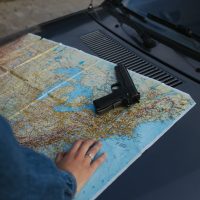
You packed the car, mapped the route, and you’re legally carrying a firearm. Then you realize the drive takes you through three states — and you’re not sure which laws apply.
This is one of the most common — and most misunderstood — situations gun owners face. What’s perfectly legal at home can become a serious criminal offense the moment you cross a state line without knowing the rules. This guide breaks down what federal law protects, where that protection ends, and what to do when you get pulled over while traveling with a gun.
The federal safe passage provision
The Firearm Owners Protection Act of 1986 (FOPA) includes a critical protection for gun owners traveling between states. Under 18 U.S.C. § 926A, you may transport a firearm through any state — even one with strict gun laws — as long as:
- You are legally allowed to possess the firearm in both your origin state and your destination state
- The firearm is unloaded
- The firearm is in a locked container other than the glove compartment or console (a locked case in the trunk works; under the seat does not)
- Ammunition is stored separately from the firearm
Meet all four of those conditions and federal law provides a safe passage defense — even if the state you’re driving through would otherwise prohibit that firearm entirely.
This matters most in states like New York, New Jersey, and Maryland, where gun laws are far more restrictive than in most of the country. Without FOPA, a law-abiding gun owner passing through could face felony charges for simple possession.
What FOPA does not protect
The safe passage provision has limits that catch many gun owners off guard.
You cannot stop for longer than “necessary.” If you pull off to spend the night at a hotel, visit a friend, or do anything beyond fuel, food, and emergencies, courts may rule that your travel is no longer continuous and FOPA no longer applies. Overnight stops in restrictive states are risky.
It does not apply to carry. FOPA covers transporting a locked, unloaded firearm — not carrying a loaded, accessible one. Your concealed carry permit from your home state does not automatically give you the right to carry in every state you drive through.
It does not cover all firearms. FOPA’s protection extends to firearms that are legal in both your origin and destination. If the firearm itself is banned in your destination state — certain magazine capacities, short-barreled rifles, suppressed weapons — FOPA’s protection may not apply.
Flying is different. FOPA covers ground transportation. Air travel is governed by TSA regulations and requires declaring firearms to the airline, transporting them in a hard-sided locked container in checked baggage, and following specific rules. Carry-on transport of firearms is prohibited regardless of your permit.
Concealed carry reciprocity: know before you go
A concealed carry permit from your home state may be recognized by other states — but not all of them, and the rules vary.
Reciprocity agreements between states mean that State A will honor State B’s carry permit the same way it honors its own. But these agreements are not universal. Some states recognize nearly every other state’s permit. Others recognize only a handful. A few recognize none at all.
Before traveling, check reciprocity for every state on your route — not just your destination. There are several ways to do this:
- Your state’s attorney general website typically lists which states honor your permit
- The U.S. Concealed Carry Association and similar organizations maintain updated reciprocity maps
- State police websites often publish current reciprocity information
Do not rely on information that is more than a few months old. Reciprocity agreements change, and a revoked agreement you didn’t know about can result in a criminal charge.
What to do if you’re pulled over while traveling with a firearm
Getting pulled over with a firearm in your vehicle while traveling through an unfamiliar state is exactly the kind of situation where knowing your rights matters most.
First: know your disclosure obligation. Some states require you to immediately inform an officer that you are carrying or transporting a firearm. Others do not. If you’re in a state that requires disclosure, lead with it — clearly and calmly:
“Officer, I want you to know that I have a legally owned firearm in the vehicle, secured in a locked case in the trunk.”
If your state does not require disclosure, you are not obligated to volunteer the information. However, if the officer asks directly whether there are any weapons in the vehicle, answer honestly.
Keep your hands visible. Before reaching for your license, registration, or anything near the firearm, tell the officer what you’re about to do and where those items are located. Sudden movement in the direction of a weapon creates unnecessary risk.
Do not consent to a search. If an officer asks to search your vehicle, you have the right to decline. You can say calmly:
“I do not consent to a search of my vehicle.”
If they have probable cause or a warrant, they may search anyway — but your refusal is legally significant. For a deeper look at how vehicle searches work, see our Fourth Amendment guide.
Do not argue at the scene. If you believe your rights are being violated — if an officer is insisting your firearm is illegal despite your FOPA compliance — stay calm, comply physically, and document everything. The roadside is not the place to litigate constitutional questions. That’s what attorneys are for. (Our Find an Attorney page can help you locate one.)
States that require extra attention
While FOPA provides important protection, a handful of states are known for aggressive enforcement of their own gun laws and complicated legal terrain for traveling gun owners:
New York, New Jersey, and Maryland have some of the most restrictive gun laws in the country and have been the sites of high-profile arrests of travelers who believed FOPA protected them. Attorneys who specialize in gun rights have repeatedly had to defend clients in these states. If your route takes you through any of them, ensure your transport is fully FOPA-compliant — locked case, unloaded, ammunition stored separately, no unnecessary stops.
California has restrictions on certain magazine capacities and firearm features that may mean a gun legal in your home state is prohibited in California regardless of FOPA.
Hawaii has extremely strict gun laws and is generally not a place to assume any reciprocity or easy travel compliance.
The safest approach: research every state on your route before you leave, not after you arrive.
A quick-reference checklist for traveling with a firearm
Before you leave:
- Verify you are legally allowed to possess the firearm in both your origin and destination states
- Confirm reciprocity for your carry permit in every state along your route
- Unload the firearm completely
- Place the firearm in a locked hard case
- Store ammunition separately
- Know each state’s disclosure law for the states you’ll be driving through
- Avoid overnight stops in restrictive states if possible
Keep your rights within reach
Traveling through multiple states — especially unfamiliar ones — is exactly the kind of situation where knowing what to say and what not to say can make a real difference. Our Second Amendment guide covers the constitutional foundation of your right to keep and bear arms in full detail.
And for those moments when you’re pulled over and your heart rate spikes, having a quick-reference card in your vehicle gives you a calm reminder of your rights and the key phrases to use. The Civic Guard Law visor placard and travel card set was built for exactly this — keep it on your sun visor or in your glove box, ready when you need it.
Shop Know Your Rights Visor Placards & Travel Cards →
This article is for educational and informational purposes only and does not constitute legal advice. Gun laws vary significantly by state and change frequently. Always verify current federal and state law before traveling with a firearm. Consult a licensed attorney in your jurisdiction for advice specific to your situation.
